
A Counterintuitive Assignment:
Stone Money
Before midnight, SUN FEB 04, post a 1000-word reflective response to the story of money on the island of Yap. Find the resources for your assignment in the sidebar under the Category Stone Money.
- Listen to the three podcast segments from the Planet Money team at NPR.
- The first tells the story of the stone money of Yap.
- The second provides a deeper understanding of the role of faith in money systems through the anecdote of the Brazilian real.
- The third uses an introduction to the Federal Reserve system to provide a somewhat terrifying glimpse of the operational design of the US economy.
- Read the closely related 5-page article, “The Island of Stone Money,” by Milton Friedman.
- Analyze the abstract concept of money. In informal academic language, describe how your thinking has changed in just two days (or why it hasn’t) about money, wealth, and our faith in things we never see.
- Listen to or read enough of the source material to cite two sources besides the NPR broadcast and the Milton Friedman essay.
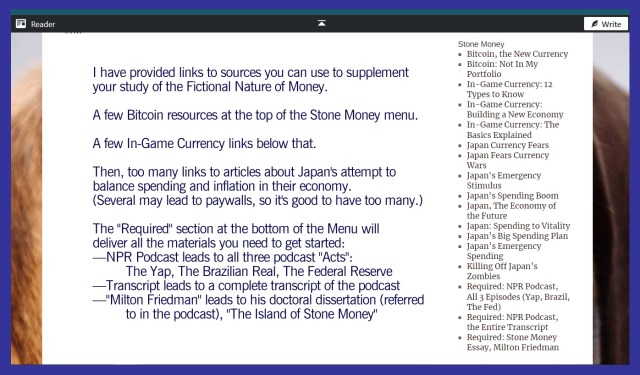
- Look for links in the blog’s right-hand sidebar under Stone Money.
.
. - Post your response to the blog as a 1000-word persuasive essay. (see Details below).
Notes: I’m not interested in your critique of the quality of the writing or the production values of the Planet Money team that produced the story. Instead, I want you to examine the thinking and the behavior of the people involved in the story: for example, the Yap islanders, the German government, the French Bank, the US Treasury, the Brazilians who used cruzeros, the Brazilians as they adapted to the real. What is their concept of money? How does ours differ from the Yaps’? In what ways was the Yap concept of money more or less abstract than ours? How fluid is the value of our money?
Sample questions to consider: What is the intrinsic value of money? How could labeling some gold in a basement vault in the US bring down America’s banking system and usher in the Great Depression? What feature of our monetary system might the Yap consider most bizarre? What made Brazilians trust the new currency? How did the recent “fiscal cliff” debate in the US raise questions about our own money as a reliable vehicle of wealth? How does the invention of cryptocurrency completely change the global monetary landscape? Are online in-game currencies even more abstract than Bitcoin, and if so, how? Should we be worried about severing the connection between money and nations?
First Draft
Sample Essay by an Actual Student
Kit-Kats for Nerds
P1. Children do not understand the value of money. On Halloween, they’ll trade a Kit-Kat for a box of Nerds, but they won’t take a dollar for that same box. Humans, on our most basic level, value trade of goods and services for something comparable in return. This system of trade has become bastardized, however, from exchange of goods to exchange of gold, to paper, and so on, until we don’t even know if what we’re exchanging even exists. For the most part, it doesn’t. It is simply numbers on a screen that tell us that we have the power to buy something that we need. So, is there really any value for children, or anyone, to understand? Does money have value anymore?
P2. In the western Pacific Ocean, as a piece of the Caroline Islands, lies the island of Yap. Its inhabitants—the Yap— are fairly unremarkable, save for how they do business. Milton Friedman, in “The Island of Stone Money,” describes their unique currency: giant limestone discs that litter the island. Their diameter can measure a foot or twelve feet, each with varying sizes of holes in the middle. The larger the stone, the more value it holds. If it seems utterly impractical, that is because it is. The stones hardly ever actually change hands, as carrying them would result in braking said hands. So instead, everyone just agrees that a stone has a certain owner. Something large is purchased, and everyone is notified that the stone’s owner has changed. One family is incredibly rich, but has never seen their riches, as they rest at the bottom of the ocean. This may seem primitive, but in reality it is not too different from the American economy.
P3. For example: In 1933, France demanded gold of the United States. Concerned about the value of the dollars they held, they wanted something more tangible in their possession to assure them of their fiscal security. However, instead of physically sending gold to the French, the Federal Reserve set aside gold for France. The actual gold did not travel anywhere, but everyone now knew that it was France’s gold. Sound familiar?
P4. This action of setting aside gold sent the country tumbling off of its fiscal cliff and into the Banking Crisis of 1933. The fiscal cliff is a relatively modern term, but can be applied in the situation of 1933. Jackie Calmes, in “Demystifying the Fiscal Impasse That Is Vexing Washington,”describes the fiscal cliff as the possible rise in taxes and cuts in spending that would take effect in 2013 due to a federal deficit reduction plan. If this one decision can send the economy into such chaos, then it must not be very stable. Any set of circumstances could manipulate the value of the dollar and its spending power, which begs the question, is the dollar really a stable form of currency? Is anything?
P5. In the NPR broadcast “How Fake Money Saved Brazil,” Chana Joffe-Walt offers evidence of the tenuous nature of currency. In Brazil, they don’t have dollars, but their currency is easily manipulated and their economy is fragile. In 1990, inflation was so horrifically high that prices were increasing by 80% each month. Prices were changing constantly, and no federal intervention was able to fix the problem. That is, however, until 1992. That year, according to the This American Life broadcast “The Invention of Money,” four economists put the Unit of Real Value into play, which was essentially currency with nothing to back it up. Prices stayed stable at a certain amount of URVs, wages were always in the same amount of URVs, everything was in URVs and inflation practically disappeared. Fake money solved real financial issues. But it wasn’t the money, it was the peoples’ faith in it. People saw that inflation had ceased and believed that the economy was fixed, and therefore it was.
P6. This goes to show how much sway public faith in currency has on the economy. Even if fake money is being used, people will see stable prices and believe in a stable economy. But who is to say what is fake and what is not? The legitimacy of money lies in what valuable commodity it represents. In the United States, that used to be gold, but in recent years the federal government has denied that gold has any bearing on the modern dollar. So the dollar is worth whatever it can buy. In one store, this may be a pack of gum. In another, it may be a child’s toy. People simply agree that something is worth one dollar, and everyone seems to accept it. But in modern times, physical money doesn’t even have to change hands in order for payment to be made.
P7. We live in a digital age, and that ushers in digital money. One very prominent form of digital money is Bitcoin, a completely digital “mine-able” currency that some businesses accept as payment. (Reeves) From the beginning, its creators have admitted to its lack of true worth, but customers mine away, spending dollars on bitcoins. At any given time, a bitcoin is worth a certain number of dollars, which is worth… what? Because of its highly speculative nature, Jeff Reeves suggests in “Bitcoin Has No Place in Your – or Any – Portfolio” that serious investors avoid it altogether. At this point, in this age of the bastardization of payment, dollars may have much less value than we have been led to believe.
P8. If anyone can make currency out of nothing—as in the case in Brazil, and with Bitcoin—then what value does traditional currency have? That is, if currency is even used, and it is not just numbers on a computer screen that tell a person that they have currency. People are told to work for this number, people die because they don’t have this number, people base their entire lives around numbers on a screen, simply because everyone agrees that that number is the be-all-end-all of economics.
P9. In the end, the United States is not that different from the island of Yap, or 1990’s Brazil, or any economy that uses money with “no value”. Items have value, such as the Kit-Kat that is traded on Halloween, or the food exchanged for labor in the dawn of economics, but obviously not the same value for everyone. Money used to be backed by valuable metals, but that is no longer the case. Virtual money is coming into power and even physical currency has no concrete backing. The only logical conclusion is that money as we know it today has no intrinsic value. We have all been tricked into believing in the URV; we all have giant stones that we agree someone owns. The economy that fuels millions of lives could disappear tomorrow and no one would have any less. In fact, the lack of a modern economy, at this point, sounds like a better idea. The world may be better off going back to trading corn for labor. At least you can eat corn. How am I going to make dinner out of Bitcoins?
References
Calmes, Jackie. “Demystifying the Fiscal Impasse That Is Vexing Washington.” The New York Times. The New York Times, 15 Nov. 2012. Web. 10 Sept. 2016.
Friedman, Milton. “The Island of Stone Money.” The Island of Stone Money(1991): 3-7. Web. 10 Sept. 2016.
Glass, Ira, Chana Joffe-Walt, Alex Blumberg, and Dave Kestenbaum. “423: The Invention of Money.” This American Life. Prod. Planet Money. 7 Jan. 2011. This American Life. Web. 11 Sept. 2016.
Joffe-Walt, Chana. “How Fake Money Saved Brazil.” NPR. NPR, 4 Oct. 2010. Web. 13 Sept. 2016.
Reeves, Jeff. “Bitcoin Has No Place in Your – or Any – Portfolio.” MarketWatch. MarketWatch, 31 Jan. 2015. Web. 10 Sept. 2016.
Professor Feedback on the 1st Draft
You’re a good writer, MyStudent. You have a nice touch. You start strong and maintain an authoritative tone. You undercut that tone too often with cute touches, but they are easy to control.
First Feedback and Grade. As you know, for this first assignment, you’ll receive a quick grade that reflects your achievement in four grading criteria (ARMS). Grades can always be improved by revision. You’ll receive your feedback here on the blog, but a quick grade on your first draft, posted to Canvas, will reflect your achievement in the areas of Argument, Rhetoric, Mechanics, and Scholarship.
Earning Additional Feedback. If you want additional feedback, you can earn it by making substantial changes responsive to my first notes. When you’ve made those changes, categorize your post in the Feedback please category and Update.
ARGUMENT —Your introduction, P1, establishes a basic argument. We used to trade tangible goods and services, which have been replaced by increasingly intangible commodities. What remains, though, is the “power to buy something that we need.” When you ask, therefore, “is there really any value?,” you’ve already answered your own question. Sure, money has value: the power to buy what we need.
You make an original argument in P1, but in P2 and P3 you merely summarize the source material to point out what it points out: that physical possession of currency is not its essential property. Surely this was not always the case, and represents the second “bastardization” after the first, which was the very idea that goods could be represented by coins.
I very much appreciate your scholarship in P4. You’ve secured a valuable outside source. Naming the “fiscal cliff” concept is not enough to make its use or relevance clear here though. I can sense its value and application, but I couldn’t possibly paraphrase your argument to anyone else without studying the phenomena myself. You have work to do here.
There’s plenty to say about P5, but I’ve already been on your post for 30 minutes.
In P6, you make a peculiar claim, that “the legitimacy of money lies in what valuable commodity it represents.” I think your essay means to describe a gradual shift from commodity (corn) to abstract (screen symbols). Somewhere in there, we stopped saying the currency issuer (government) had reserves of some inherently valuable stuff to “back” the currency. Your position on when these changes occurred shifts from paragraph to paragraph.
In P7, you say customers “mine away” as if they are creating their own Bitcoin (like minting their own dollars) instead of merely trading in Bitcoin or trading with Bitcoin.
RHETORIC—Your introduction, P1, makes good use of children’s faith in barter, distrust of money. But it needs follow-through. Children value the candy, not the dollar. You say “humans at our most basic” do too. So we’re like children. But we’ve lost our way somehow. We change work for screen symbols, or we trade Dollar symbols for Euro symbols as if they were valuable, like candy. We do so because “they have the power to buy.” Why don’t kids value the dollar? Do they not recognize it could buy Nerds from someone who has them?
Be VERY wary of Rhetorical Questions like those you employ at the end of P1, MyStudent. These do more harm than good. FAR BETTER are your bold declaratives: “For the most part, it doesn’t,” and “Money is numbers on a screen.” Your questions are teases and mostly irrelevant. You know the value of money. Your question is a different one: “Is that value secure? Is it based on something we can trust? Could my money suddenly become worthless?”
Two risks of rhetorical flourishes: 1) they distract readers from the essential argument; 2) they actually confuse readers. As an example: “Their particularly scintillating form of currency consists of sometimes giant limestone discs that litter the island.” Scintillating is completely distracting, sending us in search of some explanation. “Limestone discs litter the island” to anyone who hasn’t read Friedman means limestone discs are local phenomena, cheap as trash, not the repository of wealth. You know what you mean (they aren’t found where they belong), but readers don’t. Similarly, only your classmates could possibly understand how the rich family gains wealth from a rock at the bottom of the ocean. It’s not easy communicating the whole story in just a few words, but it must be done.
Admittedly, it’s very difficult to talk about abstracts like money and currency, but . . . you don’t carefully distinguish between US currency and dollar bills. The bills are the tangible objects. The currency is a measure of value relative to other currencies. We can trade in currencies without swapping bills, as when we buy Euros with dollars to travel to France.
MECHANICS —Use in-line citations everywhere, please. I’ve stricken the Reeves note in P9. Your inline citation in P2 is the correct style for this class:
For example. Milton Friedman, in “The Island of Stone Money,” describes the unique currency of the Yap, inhabitants of the island of Yap, in the western Pacific.
Regarding commas in compound sentences: “Something large is purchased, and everyone is notified that the stone’s owner has changed.” This is correct because the clauses have two subjects: something and everyone. However: “One family is incredibly rich, but has never seen their riches, as they rest at the bottom of the ocean.” This sentence requires no commas at all. There’s only one subject for “is rich” and “has seen.” Also, the family IS rich makes the family singular, which is possible and fine. But “HAS never seen THEIR riches” makes the family once singular and once plural. You’ll have to choose. (One choice per sentence is best.)
Either: The family IS rich but HAS never seen ITS riches.
Or: The family ARE rich but HAVE never seen THEIR riches.
The United States might be just like the island of Yap, but that’s not what your sentence means to compare. Your sentence refers to “the United States” as an “economy that uses money.” You can compare the US to Yap, or compare the US economy to the economy of Yap.
Periods and commas ALWAYS ALWAYS ALWAYS ALWAYS ALWAYS go INSIDE THE QUOTATION MARK. As in: . . . any economy that uses money with “no value.”
SCHOLARSHIP—Once you replace your current citations with the inline version, I’ll be able to judge better how well you attribute ideas to other authors. The “fiscal cliff” source is a very good idea and will earn you credit once you incorporate it better into your argument.
ASSIGNMENT DETAILS
- DUE: Midnight Sunday (11:59 pm SUN FEB 04).
- Publish your assignment in two categories: Stone Money Draft and the category for your Username found under Author.
- Give your post the title Stone Money–Username, substituting your own username, of course.
- Cite two sources in addition to the NPR broadcast and the Friedman essay.
- I have provided some links on Bitcoin and In-Game Currency and Japan’s inflation that might interest you, but you’re welcome to seek your own sources.
- Include References.
- 1000 Words not counting the References, but thorough analyses of whatever length will be graded higher than superficial writing that wastes words. Complex ideas briefly expressed are rewarded best.
- You will receive just one grade for this draft, which is intended to diagnose your abilities and needs. If you earn feedback through substantial revisions, you’ll receive guidance to help you improve your grade, one time, with a Rewrite.
- Late penalties. (0-24 hours -10%) (24-48 hours -20%) (48+ hours, still required, but maximum grade = 50/100)
- This is a Non-Portfolio Task. (Non-Portfolio tasks = 25% of final grade)


 The Gamer 2.0
 SleepyCat
 Coffee Lover 03
 doglover7025
 Snowman10
 excellentstudent27
 Gymrat
 hockeyfan
 holistic25
 ilovebeesss
 ilovemydog
 The Gamer
 Naturechild101
 BreakingBad45
 ravensfan8
 temporal111
 thatpersonoverthere
 toetio
 username1132005
 Calm&Patient
 webbwrestler135
 Counterintuitive Spring 2024
Stone Money – Gamer 2.0
An island in which currency was in the form of Rai stones also known as “Stone Money” had become of great significance for this economy. It started from 1899 to 1919 in the Caroline Islands where there was a German colony in Micronesia called the “Island of Yap”. In this civilization of five to six thousand, they had a medium of exchange they called “Fei” which were stones that were made from limestones found on an island some 400 miles distant and transported in canoes and rafts.
The German Government assumed ownership of the Caroline Islands in 1898, which led to many events. The roads and pathways were all in bad condition and needed to be fixed, the people were not involved or willing to fix the roads and with that, the government had to take action. It was decided to impose a fine for disobedience on the chiefs of the districts by simply marking a certain number of the most valuable ‘ ‘Fei” with a cross in black paint to show that the government was in control. This action sparked the turn which worked perfectly for the government and made the people begin to work on repairs and the government sent agents to erase the marks on the crosses.
The Bank of France feared that the U.S. would not stick to the gold standard at the traditional price of $20.67 so they had come up with a plan that would hit the U.S. in a way they didn’t expect. France had told the Federal Bank of New York that they should separate their gold from the U.S., they did by labeling and marking it indicating it was property of the French. This led to a headline in the newspaper that “the loss of gold” threatened the American Financial system and surprisingly the value of the gold had gone down and the French’s skyrocketed. All of this led to the banking panic of 1933, also known as the Era of the Great Depression; this was very similar to the situation within the German government. Both parties were very smart in their decisions, leading them to great success in getting the East they wanted.
The similarities and differences between “Bitcoin’ and “in-game currencies” are simple because they are the same but slightly different. Even though they are both categorized as digital or virtual currencies designed for the virtual world they both serve a purpose. Bitcoin is used for many things for example an alternative investment, to make purchases from merchants or retailers, peer-to-peer transactions, etc. And it’s also determined by market demand and supply. In-game currencies are also digital or virtual currencies designed for the virtual world specifically designed for the virtual world and particular video games. Its value is based on and limited to the virtual environment. They are mainly based on game transactions such as buying and purchasing items, upgrades, or features in the game, not the real world. In the end, in both scenarios, if there were to be a crash in the Bitcoin industry and you had money in the system you have the possibility of losing everything. So as in “in-game currencies” if the game were to be deleted or go offline you also have the possibility of losing everything you have paid for.
The Brazilians have suffered from inflation for many periods which has led to an increase in the prices of everything around them. They had people that adjusted the prices and because there was so much inflation people would run and try to get in front of the person that changed the prices. They had to come up with something that would help so they came up with different solutions like higher pay but that would end up making things worse because as prices rose the value of the money would lessen. Cruzeiro was the official currency of Brazil but it was replaced with Brazilian real which is now the new currency after the many different periods of inflation. The Brazilian real was a way for the economy to stabilize and attack the inflation that was rising and it worked and it marked a turning point for the Brazilians and its economy. The Brazilians had trusted this plan in hoping that it would give them a change stabilize the economy and fix the hyperinflation.
The U.S. currencies differ tremendously from the Yaps’ because the U.S. is one the world’s largest and most developed economies with a diverse range of industries and the Yap has a lesser economy with limited resources and remote location. Our concept of money differs hugely because the Yaps have it as coins and we as paper so it all could have different meanings and so on but if you were to compare their values the U.S. would be leading because the demand for money is so high due to the number of people that live here. The Yap’s money is more abstract than ours due to the way it is made and valued they would deem it more valuable because of how it is portrayed but a benefit of U.S. currency is that if we were to mark an X on the paper it value is still there but for the Yap, the value of that would vanish until erased.
The question of should we be worried about serving the connection between money and nations? It’s a simple answer to me I do think that they should be worried because if a nation’s currency were to somehow deplete it would lose all its allies and resources because they would have a way of purchasing more and slowing but surely would lead to economic depression. And following would be another nation taking control over that nation.
References
Friedman, Milton. “The Island of Stone Money.” The Island of Stone Money(1991): 3-7. Web. 10 Sept. 2016
Glass, Ira, Chana Joffe-Walt, Alex Blumberg, and Dave Kestenbaum. “423: The Invention of Money.” This American Life. Prod. Planet Money. 7 Jan. 2011. This American Life. Web. 11 Sept. 2016.
Joffe-Walt, Chana. “How Fake Money Saved Brazil.” NPR. NPR, 4 Oct. 2010. Web. 13 Sept. 2016.
Renaut, Anne, “The bubble bursts on e-currency Bitcoin” AFP News, 13 April 2013
LikeLike