
Wake up
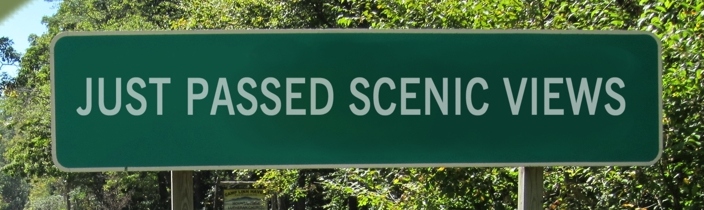
Riddle: Just Passed Scenic Views
…..
Just-in-Time Citations

Visual Rhetoric Unit
…..
.
.
Something from the Bar?

…..
The Opposite of a Black Sneaker


…..
…..
…..
I prefer David or Dave, but students uncomfortable with first names can call me Professor or Mister Hodges. My ESL students' charming solution, Mister David, is my favorite by far.
 The Gamer 2.0
 SleepyCat
 Coffee Lover 03
 davidbdale
 doglover7025
 Snowman10
 excellentstudent27
 Gymrat
 hockeyfan
 holistic25
 ilovebeesss
 ilovemydog
 The Gamer
 Naturechild101
 BreakingBad45
 ravensfan8
 temporal111
 thatpersonoverthere
 toetio
 username1132005
 Calm&Patient
 webbwrestler135

 Counterintuitive Spring 2024
There are a small percentage of people that are truly primed to read what you have to say and you have to appeal to them, though others may find different points of view of your essay.
The just passed scenic views sign seeks to tell almost nothing, if it was placed a few feet back and reworded it would be perfect
It’s important to reinforce the reader’s trust, it’s like steel, it should only give when you want it to give. And we do that by giving them information upfront, they’re adults they can handle it
Watch an ad council video that is 30 seconds and analyze it second by second
LikeLike
These are lovely reflections:
3/3
LikeLike
You find bits of evidence then put that evidence together into a shape and call it the Big Dipper.
The point of the ‘just passed scenic views’ sign: it’s way too late to be telling a reader what to expect after it’s already gone.
Authority of our voice is what we have as a writer in this class.
Prep your readers for the facts you have by first providing evidence to your claims.
Starting with the claim is the best way to start most paragraphs.
Your ideal reader is somebody who’s interested in the subject but doesn’t already know enough about it to have a strong opinion.
Visual rhetoric has 2 interpretations: 1) I don’t know. How could I know from the photo? 2) there’s an answer because it feels real based on conclusions your brain jumps to.
Job #1 of visual rhetoric: Describing images so well your reader doesn’t have to see them.
Ad’s depend on stereotypes and the audience jumping to conclusions.
What details from the video gave you the impression you got?
Before you get it second 2, you need to fully explain second 1.
At the end, you will explain whether the video was effective in their viewpoint.
LikeLike
This is Holistic25’s class notes
LikeLike
Thanks, Holistic.
This is beautiful
I have this to say. (Probably should have said it during class. Remind me on Wednesday, please, if you agree it’s important, and if I forget to mention it . . . .)
—If you draw a conclusion from the images you’re shown, and if that conclusion DOESNT’ MATCH the creator’s intention, . . . the CREATOR failed, not the VIEWER. We’re SUPPOSED TO drawn reflexive conclusions from the images we’re shown. THE CREATORS HAVE JUST 30 SECONDS TO PERSUADE US! That’s too brief for careful, nuanced debate.
As the viewer:
—EXPECT MANIIPULATION
—EXPECT TO RESPOND REFLEXIVELY
As the Author/Creator:
—LEARN TO MANIPULATE
—LEARN TO APPEAL TO REFLEXES.
Grade 4/3
LikeLike
We are formed of things where we learn and that we are told. We do not see the world as pure, as if we were just born. We have ways of interpreting things by what we have learned and seen as we have grown up. There are very few readers that are actually your readers.
Slogan: things aren’t things until you name them: Orion did not exist until someone said this constellation reminds me of something.
Riddle: just passed scenic views: It does not help you see scenic views, it does nothing for you but mess with you.
The point of the visual rhetoric assignment is to find your ability to describe something you are looking at to those who do not see it. Your job is to figure out something about the reader.
If you ever need extra credit, you can go back and watch the 60 second version of your short video and see if you notice any differences.
LikeLike
Your Notes are 3/3, HockeyFan. If that’s what you want, I’m fine with that. You can let me know in a Reply that full credit is plenty. I won’t badger you after that if you do.
But if you strive to excel, here are some alternate phrasings of your Notes for today, Notice how just a smidge more analysis can make the difference between 3/3 and 4/3.
—Our opinions are formed of everything we learn and are told. After infancy, we do not see the world as pure, as if we were just born. We interpret all new information based on what we have learned and seen as we have grown up. We are probably not your Ideal Readers; they’re rare.
—No group, no idea, no trend, no category exists until someone notices the connections and the pattern and names the phenomenon. Orion was random stars until someone said this random batch of stars reminds me of something.
—There IS NO MISCONDUCT PENALTY in MLHockey until somebody defines a Penalty and then distinguishes, by a matter of degrees, between a Major Penalty and a Minor Penalty, and the degree to which an infraction has to exceed the standards for a Major Penalty to be classified as a Misconduct Penalty.
—The sign is too late the prepare the driver or passengers to fully appreciate what’s ahead. Nobody . . . I mean, NOBODY! . . . wants to go back in the essay to see the missing setup to the important argument.
—The point of the visual rhetoric assignment is describe something you are looking at to those who do not see it. If you’re successful, your reader will know NOT ONLY everything you saw, but also WHY the creators showed you every image.
Provisional Grade 3/3
Care to improve it?
LikeLike
1.Who Reads Your Stuff?
-Only a few people really care about what you write. You need to write for them, even if others might see things differently.
2.Just Passed Scenic Views:
– Mistake: Sign placed after the scenic views, disrupting the reader/viewer’s flow.
– Solution: Place the sign ahead of the scenic views for better comprehension.
– Example: Poll statistics presented in reverse order, causing confusion.
3. Writing Center:
– Offered help for students in the Campbell Library by experienced tutors.
– Services include support at any stage of the writing process.
– Improve writing skills and academic success.
4. Just-In-Time Citations:
– Paragraph example: Late introduction of quoted material.
– Importance: Quotes should confirm existing arguments, not introduce new ones.
– Example: Effect of pitch clock on batters and pitchers analyzed.
5. Visual Rhetoric:
– Description of an ad’s visual elements and implied messages.
– Focus on composition, characters, setting, and implied narrative.
– Example: Detailed analysis of a diner scene, highlighting character interactions.
6. Portfolio Task:
– Assignment overview: Analyze a 30-second Ad Council PSA in detail.
– Describe visuals second by second without showing screenshots.
– Analyze both visual content and rhetorical strategies used.
7. Assignment Specifics:
– Find a suitable PSA from the Ad Council’s 30-second videos.
– Analyze visuals and rhetoric, detailing changes second by second.
– Provide a link to the selected video for reference.
-Due on sun 23rd.
LikeLike
Snowman, I will never doubt your ability when you come up with phrases like this one:
And, as good as that one was, this one is just as bad:
We are formed by the things that we are told and the things we learn. We do not see the world pure since we are conditioned to see the world a certain way.
Things aren’t things until they are named. Just like the constellations. They wouldn’t exist for people who can’t see that group of stars or have that relationship with them. This is just like our writing. We can take points and use them as evidence to shape it as support for our writing.
We can prepare our readers by providing them with the conclusions and then supporting the conclusions with evidence.
Describing the images we see so well that our reader doesn’t have to see them is the goal.
To the best of our ability, we should describe what is going on in the visual.
We have until Sunday, March 24 to do the first draft of our visual argument.
LikeLike
Really close, ILoveMyDog:
What I’m looking for is:<blockquoteDescribing the images we see so well that our reader doesn’t have to see them to KNOW WHAT THEY MEAN is the goal.
3/3
LikeLike
-We do not see the world pure like we were just born
-Try to tease the people in the middle that can be persuaded and hopefully they can change sides by the end of the argument
-Everything that you bring to a paper should be a pattern. Get all your information and observations and put them together in a way were other people have never did it before, kind of like how people put the stars together in groups
-Do not just drop a random quote in the middle of the argument
-Everyone has an opinion, you are allowed to state your opinion just have facts behind you that rightfully support your opinion
-Prep your readers for the facts you have, do not just drop a meaningless number. Start with a claim than back the claim up with your stats or information that you have so that the reader is not confused on what they are reading
-Head over to the writing center to maybe get another reader to review your work
-Point of Visual Rhetoric: Describing visual things in a video or photo that other people do not see or that other readers have not seen
LikeLike
Nice work, RavensFan.
I was thinking more like:
Grade 3/3
LikeLike
– We are formed by the things we learn because our brains don’t let us see the world pure, as if we’re just born. Humans interpret things the way they’re taught to do so. That’s why it’s so hard to change a reader’s mind, the ideal reader will be your main goal.
– The purpose of the argument assignments is to collect all the evidence we can and connect them for readers to understand the bigger picture we are trying to make.
– Riddle: It’s way too late to tell the reader to go back to reread the “most important” bits, they will find it unnecessary. Don’t tell someone to go back to see something they’ve already seen. If you deliver information when you aren’t ready to support it, it’s not useful.
– Just-in-time Citations: when the reader has been prepped to know the information you are presenting, you’re not having them do a merry-go-round to understand the points you are trying to make.
– A visual could carry a lot more information than another visual but the conclusions drawn are based on what we believe. Describe images clearly so you can communicate to readers who cannot see themselves.
– The visual rhetoric assignment is due this Sunday. The task is to pick a 30-second PSA video from AD Council on YouTube and use a timeline approach to indicate what happens at every second(or every few) without showing screencaps.
LikeLike
Love this:
4/3
LikeLike
-Wake up: We see the world in certain ways depending upon how we interpret certain things. What we hear and see and know can all contribute to that. The people who already have an opinion on what they read are still only at about sixty percent on their opinion. They can still be persuaded even though they are viewed as lost causes. This might be because the writing might tease them to possibly be persuaded.
-Things are not things until they are named: Because people study what they do, things can exist. Once things are named they exist. People say what something is called and everyone goes along with it. The big dipper would be an example. People now call that pattern the big dipper every time they see it. The paper written should have patterns. The reader should be able to put things together that they can’t deny. Once it is named people to start to look into it and believe it more.
-Riddle: Just passes scenic views doesn’t help a driver. They don’t want to know what they already passed and missed. They want to see it before they get to the sign. A quote should never just be dropped in a paper. There should be a build up and details to get the quote ready before dropping it. A reader can make up their mind right away when the quote is dropped. They can lose trust in the writer to tell them what the quote means. They don’t want it randomly put in, they want the quote to have a build up and some explanation before going into it. The reader should be able to get a warning as to what is coming next and what it means before it is written or shown.
-Visual rhetoric: The point of visual rhetoric is to try and convey a message to the reader or audience using an image or something they can see and the point is for them to understand the meaning without any explanation or meaning.
LikeLike
Excruciatingly wordy, but there’s good thinking in this:
4/3
I’ll give you 5/3 if you can say as much or more in fewer than half the words.
🙂
LikeLike
-We are formed of the things we are told, and we do not see the world pure, as if we were just born. We interpret the world, and we have ways for interpreting things in regards to things we believe in. That is why it is so hard to change our minds, and why there are very few readers who are actually our readers.
-Things aren’t things until they’re named. Putting together observations makes a group. The thing that was put together and created, turns into the definition argument.
-Riddle: Just passed scenic views. With the argument, if you have a quote, some people may not understand it to understand why it was said. Even though they have an opinion on why it was said, it’s way too late to tell people what to expect after they already read what you wrote, and in the way you want it to come across. The authority of our voice is important.
-Visual Rhetoric Unit: Our persuadability can change from seeing visuals. This unit is to see how well you can describe things that you see like images so well that the reader does not have to see them. Using descriptive language so well you can show visuals, even if the reader does not see it. Tiny details can make all the difference. We need to explain why the visual made us know something about the characters. The details are very important for this assignment. Explain what you see second, by second in a video for this upcoming assignment due on Sunday the 24th.
LikeLike
Yeah. Like this:
4/3
LikeLike
We interpret things based on our experience, our interpretation isn’t pure
Certain things (such as an abstract group) only exist if we name them. Ie the stars in constellations exist beside us, but the arbitrary grouping of certain stars, and naming of said group only existed with humans, as it really only is a concept we developed
Don’t drop evidence where the reader isn’t looking for it, like don’t put a quote randomly and then explain it later
The only authority or credibility you have in your essay is your evidence and reason, unless you’re writing about israel and you’re the chairman of the whatever
LikeLike
Joint Chiefs of Staff.
3/3
LikeLike
We are told how to see the world, we never see the world pure. We do not see the world the way we do when we are first born, everything changes based on experience and influences.
Sometimes things are put together by one person which changes the perspective of everyone because it is in a way that no one has ever seen before but happened to make sense of it
Things do not exist until they are named, could be nothing and man-made, only seen by some but that is how they start existing
Example: big dipper
Do not drop your best evidence where the reader is not looking for it, because then it loses its purpose and it does not have meaning anymore
The right time for the quotation is when it confirms the argument that has already been made.
The best way to start is with your claim
Video:
0:00- the scenery is shown more old-school with the type of lighting done. With the first loss of a second zoomed in and out fast, but not looking professional makes it look like it is homemade and more realistic.
For the assignment break down the video and draw conclusions from the images being shown. Do it second by second. Watch it as many times as needed to gain all of the details. Watch it in different ways (ex: sound on and off)
Assignment due the 23rd
LikeLike
These should be Commandments:
4/3
LikeLike
•As we get older, we stop seeing this as how we saw them when we were born, and we start to see things based on what we are told and what we experience.
•The process of giving something a name gives it is meaning. Things that remain unnamed are kind of unknown.
•It is important to give your opinion and share with your readers by making them claim and then following up with supporting evidence.
•Visual Rhetoric: Visual rhetoric is typically used to try and communicate a message. It is up to the reader to interpret what the image means based off of every detail that is included in the image.- ASSIGNMENT DUE SUNDAY.
•Don’t randomly drop evidence, use it when it is most needed.
LikeLike
Yep.
3/3
LikeLike
– Our brains function to interpret according to our experiences and how it has been instilled in us throughout our lives. We do not see the world as newborns because we are not. We see ways according to the things we experience. That’s why it’s so difficult to change someone’s opinion, especially a reader.
– Slogan- things don’t exist until you name them. I took this specific thing that exists and I put it in a way that no one has put it before and created a new thing.
– Riddle – From our readers’ point of view, you drop something on me unprepared which causes me to immediately form an opinion about it and now you want to explain to me what you could have said in the first place that contributes to your argument? It’s too late to explain something that has already been decided. A real reader will give up on you if you drop things you didn’t explain at the time because now they have an opinion about it and won’t care how you tried to justify it later.
– I’m the author that is the only authority I have.
– You start with a claim, then you can drop the evidence. In other words, you make your claims tease the reaction and then you drop the evidence that satisfies the conclusion. For example: I have a thing to say and it will confuse you for a moment but I will provide you enough evidence to agree with my authoritarian views.
– Visual rhetoric- how well can you describe what you see to people who can’t see it
LikeLike
So much to love here, ILoveBees. My favorite is “authoritarian.”
4/3
LikeLike
-We took a look at the Vincent Van Gogh famous starry nights painting and watch and illusion on it and how it was meant to be looked at as stars in the nights sky moving but without the illusion you don’t see that.
-Just passing the scenic view is an example of giving information after someone has come up with their conclusion of the story. Just like the sign it says Just passed scenic views the sign comes way too late and you missed the view because you didn’t know it was coming till later.
-Visual Unit- No money, the image can be said into many different things like she has no money, she has a hole in her pockets, her pockets are stretchy there are many different outcome and you as a writer have to express and going into detail to the best of your ability.- the point of this is to see how you’re able to describe an image and explain it to the reader so that the readers don’t have to.
-The Ad”Now” video can be explained without even needing audio because the entire video has the images and everything you need to understand the story that is happening
LikeLike
Telling everything with the images is just one way to communicate, TheGamer. Some of the Ad Council 30-second spots tell almost everything visually. Others rely heavily on the dialogue or other audio elements.
3/3
LikeLike
Starry night painting illusion.
-After staring at the center of a screen which shows us a swirling image, the video transitions over to an image of Van Gough’s starry night, which appears to be moving. If you do not stare at the center of the screen, you will notice no movement as the image contains no animation. The movement is an illusion created by your mind. This is a fun example of how our minds can be tricked and a good introduction to today’s more visually focused lecture.
Constellations
-Constellations are collections of stars which are grouped together because of the patterns they form in the night sky.
-The stars in constellations are only related to each other through the patterns we perceive. These stars are lightyears apart from each other, and from any other perspective they would form a different pattern.
-As a side note, the big dipper, while very recognizable, is not an official constellation, it is an asterism, essentially an unofficial constellation.
Many people will already agree or disagree with your argument before you even present it to them. However, some of these people can be made to consider your point of view if you alter how it is presented to be more palatable to their perspective.
Riddle: Just Passed Scenic Views.
-The sign shown to us reads “Just Passed Scenic Views.” This is a bad sign because it tells its viewer about a scenic view too late, and if the audience wants to see it, they will have to go back. If you replace the sign with your argument, this riddles relevancy to the lesson becomes clear. Placing your argument at the end forces your reader to backtrack, which is something very few will do.
Visual rhetoric unit
-Images can be used to quickly represent large amounts of information.
-The example is an image of someone showing the inside of their pockets, a visual shorthand for someone having no money.
-The information we gather from these images is based on assumptions our brain makes. For example, we may assume the person has no money because their pockets are empty but for all we know they have money elsewhere.
LikeLike
Fucking brilliant.
Reading your notes gives me the impression that the professor had a plan and a clear vision. I’m showing you stars, and you’re forming constellations.
I’m writing a play in which a father and son in a minor incident scan the night sky and make up their own constellations including: Barry the Knife Sharpener, Cecil the Hunchback who Gutted Fish, Celeste the Red-headed Ice Cream Vendor.
5/3
LikeLike
As mentioned previously, “We are formed of the things were are learned and the things we are told”- just like the starry starry night illusion.
There are very are few readers who are actually your readers
“Things arent things until theyre learned” —- you think what you put down on paper…. Orion didnt exist until someone did research and came up with it.
Riddle- just passed scenic views
-It doesnt function because you werent paying attention to see the scenic views, similar to visual rhetoric essay…
Visual rhetoric unit- to see how well you describe things youre looking at to people who will not see them.
Assignment- watch 30 sec and describe everything in video by the second its due 3/24
LikeLike
Nobody had to research Orion, but I get your point. WE have to research to see the new patterns. Once we find them, the best way to sell them to the reading public is to name them.
3/3
LikeLike