With the time spent reviewing the recent terrorist attacks against Charlie Hebdo, it’s been difficult for me to form an opinion regarding the pairing of the words “Je Suis Charlie” (I am Charlie) and the quite different version of Charlie Brown; the more aged and morbid appearing version. The image that portrays the aged Charlie could be argued to represent the old-timed character gone wrong, a reality where Charlie had taken a path no one could have predicted. An apparent correlation between the aforementioned pairing of picture and words without reading too much into it doesn’t come easy as it isn’t obvious how the modified Charlie Brown could correspond with despair and tragedy. This is other than my one and only conclusion that the picture may symbolize the unforeseen path of events, however, taking into account the history of the group responsible for the Hebdo attacks, the events could have been predicted by anyone, Nostradamus or not.
The attacks were led by Al-Qaeda members from Yemen who have taken offense to the magazine’s satire of their prophet. Threats have been made by radicals many times in the past before. For example, not too long ago Comedy Central was “forced” to pull the images of Muhammad from a South Park episode immediately before it aired due to threats against their studios. This displays the groups’ (radicals in general, not just Al-Qaeda) sensitivity and intolerance to satire involving their prophet.
Further analyzing the image, it shows Charlie looking malnourished and disgruntled, with a lack of self-preservation and possibly hygiene. With a closer look, it seems that Charlie might be upset or disappointed with someone or something. It could even be asserted that the image paired with the phrase could mean Charlie represents the Charlie Hebdo magazine company as a whole and how they feel with the onset of violence. They might feel lost, like they are stuck on a path similar to the eerie version of Charlie Brown.
Even that, for me, is reading into it a bit much. It is my firm belief that the designer merely wanted to bring a familiar face into the campaign for awareness. There certainly is no Charlie more recognizable than the one and only Charlie Brown! Why the artist made said modifications to Charlie, however, still remains a mystery.
The massacre of cartoonists in Paris has caused widespread sorrow and darkness to a profession that is usually chipper and humorous. Islamic extremists methodically took out cartoonists working for Charlie Hebdo after the cartoonists published a drawing of the Prophet Muhammad. This supposedly angered the group of extremists to the point of violence against unarmed people.
The massacre of these cartoonists has led me to believe that free speech is not as perfect and golden as we think. Yes, we all have the right to say what we want (to some extent) and express ourselves as we wish, but there’s a line that has to be drawn between freedom of speech and obscenity. It’s one thing to poke fun at political pundits or troubled celebrities, but when it comes to blatant disrespect of a religion, that’s taking it too far. From what I’ve seen of Charlie Hebdo’s cartoons, I’d say a decent amount of them are quite controversial. I’m not saying these people deserved to be murdered in cold blood, or the extremists have justification for killing people, but those who published a cartoon that depicted Muhammad had to have known the problems publishing something that religiously sensitive would cause. People get very into their own religions and as history has shown again and again, those people are ready to defend their religion no matter what it takes.
As for the depiction of a gloomy Charlie Brown character, I believe it is representative of the sadness shared by those who show support for the Charlie Hebdo company. Charlie Brown, which is a young character in the actual cartoon, seems to be middle aged in this rendition, and I believe the reasoning for that is that cartoons are usually synonymous with children, but in this case, cartoons bring out emotions in not children, but adults.
The slogan “Je Suis Charlie” is an obvious coming together of citizens all over the world. I am Charlie is a slogan that has no direct subject, so I am Charlie can mean something to everybody. “I am Charlie Hebdo, I work at the company, and I was directly effected by the massacre” could be the words from an employee at the company. “I am Charlie Hebdo, I am from Paris and I am effected because this is my home” someone could say from the area. Perhaps someone could even say “I am Charlie Hebdo, I am from the United States and I want to show my support”. The slogan could also be a way to explain that if this can happen to Charlie Hebdo for expressing free speech, it can happen to any of us as well. So perhaps the slogan is a call to action too. Either way, the slogan puts out an extremely powerful message to everyone.
As an example of a visual argument analysis, I will show a brief public service announcement (PSA) produced by the Ad Council for a campaign to prevent or reduce domestic violence.
While the producers depend on the voice-over text to carry much of the argument of the piece, we’ll be concentrating in class on the part the visuals play in reinforcing the message of the announcement.
Your Challenge
Before our WED JAN 28 class (the deadline is 11:59pm TUE JAN 27), you’ll select any visual you like from the library of Ad Council PSAs and use it to produce your own visual analysis: a non-formal piece of rhetorical writing you can format any way you wish. What appears below is not meant to guide you in constructing your own analysis; it’s merely notes on my impressions as I watched the PSA a few times. My analysis is fairly thorough but not exhaustive. Even as we talked it through in class, I found and shared obvious additional commentary. Still, it’s useful as a guide to get you started.
Notes on the Visual Argument
The “ad” begins with a view of the ceiling of the couple’s apartment. They must spend quite a bit of time looking up at that ceiling, trying to imagine (or afraid to imagine) what the neighbors are doing just a few feet away from their heads.
The shot establishes that the sounds come from upstairs, not next door. This quickly indicates that the couple does not share a two-bedroom apartment with the abuser and his victim. Pay attention to camera angles and points of view (POVs) for clues like this one that contain important narrative material.
The politics of the couple’s relationship is critical to this argument. When we first see them, the man is reading while the woman is sitting upright, stiff with discomfort, riveted on the sounds from upstairs that the man is trying to ignore.
They are in bed, the ultimate setting for domestic comfort and security, but she feels anything but safe. What about the man next to her in the bed is bothering her?
She gets under the covers—to feel safe? to indicate that she does not intend to go anywhere? to get closer to her protector?
When she looks at him, is it with sadness? Yes, but also guilt? Yes, but also pleading? She might expect him to do something. She might be wondering how much she can trust him if he can listen to a man beat a woman and NOT do something. She might just be feeling helpless herself.
They are not poor. They live in a good-looking apartment with good linens and nice furniture. The implication is that violence can happen anywhere.
When the man does nothing, she turns away, not toward him. Has their failure to act (his failure to act) damaged their intimacy? Does she not want to be near him? Does she not feel as safe as she wants to feel when she’s near him?
When he puts down his book, we see his wedding band. They are married. Whether she expects his protection or not, they are making this choice together, to ignore what is going on above them. The telephone is inches away from his hand as he turns out the light. No doubt the noises from upstairs will sound even louder in the dark.
It is their business, says the slogan on the screen. And there is no excuse. For domestic violence. And no excuse not to place the call to find out how to report it.
The purpose of the ad and the argument is to reinforce an ethical appeal, to anyone aware of domestic violence, to take responsibility and at least not ignore it.
ASSIGNMENT SPECIFICS
Find a visual argument worth your while among the PSAs produced by the Ad Council.
To find them, open the video in this post in YouTube.
Notice in the right-hand sidebar of recommended related videos a large selection of 30-second Ad Council PSAs. Browse until you find one that speaks to you or one that uses visual techniques you think you can analyze effectively.
Write your Analysis of a Visual Argument (Moving Image) post.
For a sample visual analysis, study the post Thai Life Insurance in which your instructor breaks down 10 seconds of video.
An informal piece of rhetorical writing you may structure any way you wish: as a series of notes, categorized impressions, a timeline analyzing what occurs second by second, a diary of your changing attitudes toward the argument over several days, a script of the conversation you had with someone else about the ad, or any other approach you wish to take.
Do consider though that the piece will become part of your Portfolio and will therefore be a component of your 75% portfolio grade.
The Draft you publish this first week of class, while important, is merely your first draft. It WILL NOT be good enough for your Portfolio, no matter how brilliant and accomplished it is. You will be revising it considerably before the end of the semester.
You may even respond visually, if you wish.
Include a Works Cited if you quote or cite sources.
Title your post Moving Image—Username.
Publish your definition essay in the A02: Visual Rhetoric category.
GRADE DETAILS
DEADLINE: Midnight Tuesday (11:59 pm TUE JAN 27)
Customary late penalties. (Late less than 24 hours 10%) (24-48 hours 20%) (48+ hours, 0 grade)
Major Portfolio Argument(Complete Portfolio is 75% of Course Grade)
This week’s draft is a First Draft Assignment (All First Drafts together equal 15% of Course Grade)
When I ask you to analyze a visual argument from film or video, imagine you are describing the images to a reader who can’t see what you’re describing. You may understand the creator’s intentions and the complexities of the narrative, but since you’ve learned them from watching the visuals, the reader will have no basis to evaluate your judgements unless you describe the visible components of the Visual Argument.
For readers who are not watching along with you, you are not sharing what needs to be shared by saying: “since he has no money.” We don’t understand how you know this, and therefore we can’t trust your conclusion. Much more effective and to the point, explain that “he turns out his empty pockets to indicate he has no money.” Now we’ll understand what part of the argument was conveyed by the images.
Evaluate the Rhetoric
It’s also your responsibility to indicate whether the technique (the rhetorical part of the visual argument) is effective or not. One of the images below conveys cashlessness without unnecessary distractions. No money, pure and simple. The others inject extraneous and potentially confusing notes of sensuality or degradation. One is rhetorically singular. The others may be effective, but only if the cashless person is supposed to be shapely, or fit, or seedy, or disturbing.
As viewers, we’ve been trained to be widely receptive to the nuances of images. The best communicators limit the range of interpretations we can impose. When it’s your turn to analyze a visual, you’ll need to gauge how effectively the intended messages are delivered, how much the noise has been reduced.
Sample Argument Analysis
Let’s examine just ten seconds of vidcaps from a sample video and see how much we can extract from looking at a portion of an argument we don’t already know.
Looking at silent stills from the video this way, without knowing the context, and without the distractions of the soundtrack or narrative significance, we’ll have to concentrate exclusively on the images alone, at the rate of one per second, to see how we’re being manipulated.
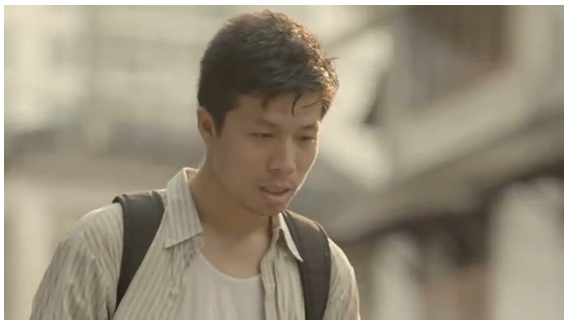
1:44
A young Asian man, probably outdoors in a city, is dressed casually and wears a backpack. He is either not well shaved or has deliberately chosen the unshaven look for fashion’s sake. His hairstyle is neat but casual and his open shirt and undershirt are clean, so the impression we get is that he is not poor or homeless but that he chooses to dress for an informal effect. He carries a pen in his pocket: industrious or at least prepared. He is looking down, either to see the curb, or something on the sidewalk, or at least something below eye level, perhaps in his hand.
1:45
By this frame, we’re seeing a hint of something brown and rectangular in his hands. Our immediate impression is that it’s a wallet but we can’t be sure. Passport? Map? It is clearly occupying his attention, but also he is still walking, so he must know where he’s going; otherwise, he’d have to be more careful stepping. So: will he be spending money on something he routinely buys?
1:46
Here, instead of seeming to be involved in a routine, the man looks surprised. His open mouth might indicate he wants to ask a question. His narrowed eyes give the impression he wants to focus carefully to make sure he’s seeing what he thinks he’s seeing. That combination of confusion and disorientation might indicate he is worried about what he’s seeing.
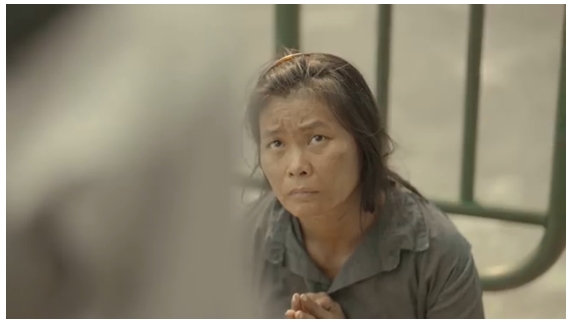
1:47
A woman is looking up. We assume she is looking at him, and that, given the angle of their communication, she must be standing in a deep hole, or seated on the ground, sidewalk, or curb before a pedestrian barrier that subtly suggests prison bars. Is she trapped or confined?
The fact that he walked right up to her without worrying about where he was going indicates he is accustomed to finding her here (and perhaps that he uses his wallet when they meet).
She is perhaps his age or a bit older, not much. She is not disheveled or unclean, but neither is she fashionable or “put together.” Her drab open-collar shirt might even indicate she’s poor. She is clearly quite troubled from the furrowed brow and pressed eyebrows. Her hands are folded too. Has he interrupted her at prayers? Or is she asking (begging) for something from him?
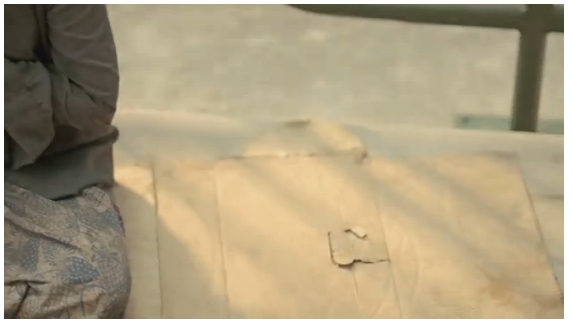
1:48
The camera pans down to reveal that she is in fact sitting on the ground, more specifically on a piece of cardboard torn from a shipping carton as we can tell from the torn die-cut handle. In other words, she’s sitting on some trash she brought here for this purpose.The cardboard is wider than it needs to be for her. Next to her is what we might call, an “empty seat.” Is she perhaps waiting for him to join her? Or has she lost someone? Is it possible he has always given her money (the wallet? the sure steps in her direction?) and that her being alone is surprising or disturbing?
But that can’t be. Unless a person just got up from this “seat,” the cardboard wouldn’t be folded out to the woman’s left. She’d fold it under herself. What can it mean? Did someone just disappear from this street corner?
It would have to be someone intimate, even related. Friends or acquaintances would have their own cardboard; they wouldn’t share.
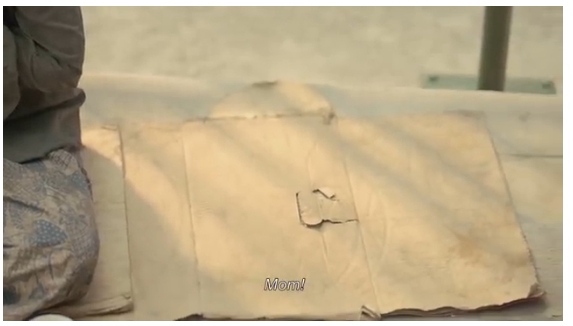
1:49
The word “Mom!” appears as a subtitle, with an exclamation mark! Not a label, then, but someone’s call. Somebody is calling Mom. Oh no. Has the man’s mother always sat here on this bit of cardboard where the man visits her often, but today she’s gone, sick, injured, missing? If she’s dead would the cardboard still be there? If she’s nearby, what has happened?
1:50
The woman, hands still folded, looks up. Has she heard someone call Mom? The implication is that she might be responding to the call, but does that mean she’s Mom? Or that she’s looking to see who might be calling out? The man, we presume is still directly in front of her, so she’s looking off to the side, not at him.
1:51
When the man spins to his right, he is clearly looking down the sidewalk. The woman, when she looked up and turned to her left, must have been looking down that same sidewalk. His mouth is still open. He still has unanswered questions. His eyes are focused on the distance so we guess he’s looking at someone standing fifty feet away or coming in his direction. Is it the person who called out Mom? The woman’s child?
1:52
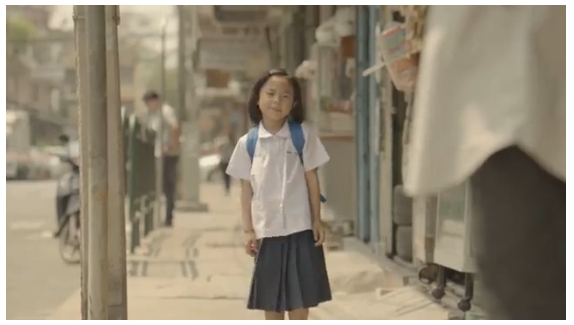
It’s a schoolgirl in an unmistakable schoolgirl uniform. The bit of stitching above the pockets is probably the name of the school. Like the man and woman, she’s Asian, a girl of six or seven maybe? An early elementary school child.
Her untucked shirt and the straps of her blue backpack are clear echoes of the young man’s outfit. Maybe that’s why he has a pen in his pocket. He could be her teacher.
But her shirt is neatly pressed, maybe the nicest garment in the video. It cost money to buy and to keep clean. The school she goes to costs money. Does the man (her teacher?) pick up this child on the way to school every morning? Was she just momentarily away from the corner on an errand? She called out Mom!, we now assume, but in the right of the frame, the man’s clothes are visible.
She could have seen him as well as her mother on the ground. So this can’t be Dad, right? Unless she now calls out Dad! She looks radiantly happy. Is she just a joyous adorable child, or has she been separated from Mom and happy to be back?
This shot confirms we are in a city. The row of barred barriers at the curb echo the one behind Mom on the sidewalk. They either protect pedestrians from runaway cars or they’re a place to lock up bikes.
The girl’s hands are empty, so she hasn’t been sent on an errand to fetch something for Mom. Is she possibly coming back from school? Good God, what if this bit of cardboard is home? How would she stay so clean?
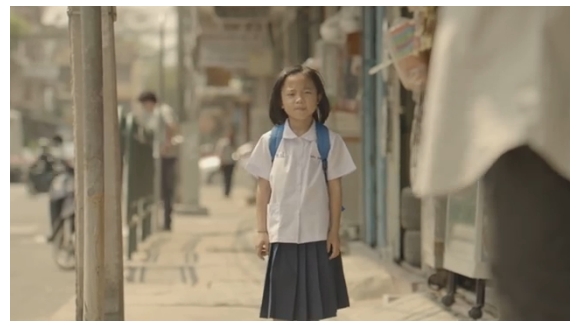
1:53
She stops dead in her tracks on the sidewalk in reaction to something not frightening but important. She doesn’t turn and flee or seem afraid. She doesn’t look back and forth from Mom to the man and back; she can handle this on her own. But she doesn’t proceed any further forward either. She is processing something at this distance. From the angle of her eyes, we know she’s looking not at Mom but at the face of the standing man.
1:54
The camera is moving slowly in her direction. Since we are seeing her from the man’s perspective, this means we are “taking a closer look at her,” moving carefully from the distant stranger position to a closer proximity where we are comfortable with people we know.
If this is her customary spot on the cardboard, the man must have been disturbed to see her missing. Now that she’s here, we should expect to see relief if we get another look at him.
1:55
What’s going on here? He looks just as confused as ever. Is he relieved to see the child he was worried was missing, gone, or hurt? Why is he not smiling at the sight of her? If he’s her Dad, this is a very inappropriate facial expression. But clearly she’s not meaningless to him. He has an interest in her.
Conjectures, please.
The Argument in Context
Now, let’s watch the argument in its entirety to test our hypotheses.
Review and Recommendation
This analysis of just ten seconds of video will remind you, I hope, what a rich medium is video for argument. We have discussed countless implications of the contents of individual frames, all of which are small claims in a larger argument. We can’t be sure how we’re being manipulated until we understand the entire argument, but watching pieces out of context gives us the best opportunity to see the mechanics of argument at work. When we watch in the “proper” sequence, with the “appropriate” soundtrack, we can be sure we’re being manipulated, and that we’re willing conspirators in our own persuasion. We’re hoping for a rewarding experience. Do we get goosebumps, or choke up with emotion, after 2 minutes of wordless video about total strangers? That doesn’t happen by accident. That happens when we’ve been persuaded by an argument to believe that something has happened (or that it at least represents a human experience that could happen).
As you prepare your Visual Argument, watch the videos as if you didn’t already know the argument.
Consider what a single frame communicates without its full context (which has been supplied to you by the video’s creator, whose job is to persuade you).
Create your own posts to include this degree of analysis and interpretation.
Decide for yourself whether to analyze the entire video, or, as I have here, just a few seconds that are particularly persuasive.
What is the Argument’s Purpose?
The text at the conclusion says: Thai Life Insurance. Believe in Good.
So, is it a public service announcement that urges us to make small differences in the world we pass through every day? No. It is not. It’s an ad for life insurance.
Make no mistake, this message from an insurance company is designed to sell men a life insurance policy to protect their children.
I admit, that sounds like an outrageous claim. You watched the video. You most likely didn’t feel you were being encouraged to buy life insurance. I didn’t either. WHILE I WAS WATCHING IT. While I was watching it, I was compelled to follow the logic of the narrative; I was swept along by the soundtrack, instructed when and what to feel; I was manipulated into seeing the patterns in the repeated images: three times the bananas on the doorknob. And so on. I was being taught something unwittingly.
Given time to reflect, though, I have decided this:
Paying for a life insurance policy every month, which does me “no direct good,” but which benefits my dependents when I’m gone . . .
is VERY MUCH like:
performing small but significant acts of generosity—such as making regular cash contributions from a light wallet with no tangible benefit for myself—for a little girl whose mother sits alone on a piece of cardboard with no father in sight and a dependent daughter to put through school.
That’s right. The young man is “paying premiums” that add up to a cash benefit for the girl whose father is gone. The young man is the stand-in for the father who dies but who has left behind a life policy with a death benefit that will put her through school.
That’s why the emotional payoff of the piece hits first when the man realizes he has helped “his little girl” get her education when there’s no one there to sit next to Mom.
OK? Get to work. Tell me a story like that one about the video you choose to analyze.
Side-by-side comparisons of every draft with changes highlighted
The practical disadvantages are not negligible
Necessitates teaching in a computer lab
Technological learning curve for students
Instructor must be proficient at posting, categorizing, linking
Danger of student distraction at monitors during class
The Mechanics
I email students several weeks before the semester begins to alert them to the plan for the course and to advise them that the course will be conducted on a blog.
I do this by posting to the blog and providing them a link to the blog where they read about the course plan on the platform they’ll be using.
I let them know there will be no textbook for the course, but that we’ll be subscribing to the New York Times as a class (Comp I), or working from online sources on controversial topics (Comp II).
The first day of classes, I sign students on to the blog as Authors.
Students choose anonymous usernames that obscure their identities.
From that day forward, we log on to the blog in every class, live but anonymous.
Agendas, assignments, source materials, exercises, submission of essays, feedback on those essays, submitting of revisions are conducted on the blog.
Grades are not posted to the blog. They are shared on paper grade reports during mandatory personal professor conferences.
Portfolios are built on the blog.
Final grades are posted on Banner.
Pedagogical Considerations
According to our Core Values, writing is a recursive social process.
Students are required to embrace the principle that their writing has consequences in the world.
We ask them to engage in the social exercise of responding to real-world materials with real-world materials of their own, which take their place in a public discourse.
On the blog, every student sees her contributions as part of an ongoing dialog among fellow students, the professor, and other authors everywhere.
Students who post ahead of the deadline get early public feedback that all other students can read to gain clarification about what is required to complete assignments.
The example is rare, but New York Times reporter David Bornstein left a comment on our blog after I characterized a conclusion he drew as having been based on anecdote. He proved that our voice mattered to him.
Responses to Assignment: A03 A Blow to the Head David Bornstein says:
January 27, 2011 at 10:49 am (Edit)
I saw this comment: “Bornstein bases his broad conclusion on one doctor’s anecdotal evidence.” Not true. The assertion is based on studies like the one below, which surveyed 900 homeless people, and was published in the Canadian Medical Association Journal. Other studies support this finding. The link to this particular study is contained in the first paragraph of the article you reference: ‘A Plan to Make Homelessness History, in the NY Times.’
I’d appreciate if you’d clarify this.
http://www.cmaj.ca/cgi/content/full/179/8/779. Study Title: The effect of traumatic brain injury on the health of homeless people
Stephen W. Hwang, MD MPH, Angela Colantonio, PhD OT Reg, Shirley Chiu, MA, George Tolomiczenko, PhD MPH, Alex Kiss, PhD, Laura Cowan, BScN, Donald A. Redelmeier, MD MSHSR and Wendy Levinson, MD
Reply David Hodges says:
January 27, 2011 at 11:25 am (Edit)
Thank you, Mr. Bornstein. I’m delighted to have your clarification. In addition to keeping me honest, it’s excellent evidence that what we say here on our class blog is published and available for a caring world to see.
The article you name, “‘A Plan to Make Homelessness History,” New York Times, December 20, 2010; is supplemental to the article I referenced, “The Street Level Solution,” New York Times, December 24, 2010. Good students will certainly read both. I’ll update the assignment to be certain they do.
Good students will also consider leaving a comment here to express their appreciation to David Bornstein for making a contribution to our blog, in addition to inspiring us with his research and writing.
Thank you, sir. I am in your debt for many reasons.
Ethical Considerations
Every student’s work is visible to everyone in the class, to the world in fact.
As incoming freshmen, they are not accustomed to “writing in public.”
They may be intimidated about exposing their writing to their peers.
The blog raises the question of when or if communication between professor and student should be private and when it can or should be public.
Feedback also occurs on the blog, in full view of classmates.
The instructor accepts a heavy burden to balance criticism with compassion.
The student who sees that classmates receive heavy doses of criticism are less inclined to take criticism personally.
Students may be “over-influenced” by the work of their peers.
Copying of rhetoric or mimicry of structure may result.
Outright plagiarism is a temptation.
Mitigating Circumstances
My experience has been that students are of course initially intimidated by the public nature of the interactions. Those who fear being criticized in full view take comfort in several facts they quickly learn:
Their identities are not disclosed.
Most of their classmates aren’t bothering to read what I say to others.
Those who do read widely soon discover that EVERYBODY gets WAY TOO MUCH criticism.
At the end of the course, the most common answer to the question “What is the best feature of the course?” is always: The Blog, or The Feedback.
Unexpected Advantage
Maintaining objectivity while critiquing and grading is much easier for instructors who don’t know whose essays they’re reading.
I need to find out right away how well you argue and how well you write.
Before MON JAN 26, post a personal, evaluative, analytical, narrative, argumentative, persuasive, categorical, or reflective response to the graphic I have used for the header and background to this blog . . . or any combination of the foregoing. If you wish, you may use and cite sources to support your analysis of the graphic, or you may express your singular and unmediated response to the argument it makes.
Or you may choose to argue with my premise that the graphic makes an argument; but I warn you, I believe all writing and every image makes an argument.
Analyze your reaction to the graphic and whether it has changed since the first time you saw it.
Relate your reaction to the opinions you formed about terrorism, provocation, and free speech during the recent news coverage of the Charlie Hebdo massacre of cartoonists in Paris.
The image is someone’s creation. The combination of the image with the text is someone else’s creation. The placing of the image on the blog as a header is someone’s choice. When you look at the image, you are reacting to the premise advanced by the artist, by the designer, and by the instructor whose choice it was to present the image to you prominently.
What did the cartoonist intend? What did the designer intend? What did your instructor intend?
How much of your reaction results from your religious or political affiliations, if any?
Is your reaction in any way defensive?
If you prefer to pretend that you have “no reaction at all to a premise that, frankly, has nothing to do with me and is not worthy of my attention,” who do you know who would applaud your reaction, and who do you know who would be appalled or disappointed in you for caring so little?
In other words, you can’t escape this assignment. The image means something to you, whether you like it or not. The harder you deny its meaning, the more difficult the assignment.
Relax. There are no wrong answers except evasive or meaningless answers.
Give your post the title Je Suis—Username substituting your own username, of course.
Notes: I haven’t categorized this assignment as analytical, evaluative, or argumentative because I don’t care whether you analyze, evaluate, or argue. Consider this assignment a poke. Turn in interest, flinch in fear, or poke back . . . or stay still but document how the poke felt. I want a writing sample that expresses your natural reactions, not your compliance with an assignment.
Mechanics and Specifications: Write as many words as you require to make yourself understood. Waste none. Reject your first draft as the crap it is. Revise it until it has a shape that persuades its reader. Reject that too. Then revise it again until it is something that won’t embarrass you for fifteen weeks. With luck, it will embarrass you in fifteen weeks.
ASSIGNMENT DETAILS
DUE: Midnight Sunday (11:59 pm SUN JAN 25)
Post in the A01: Je Suis Charliecategory.
Word count is irrelevant. Thorough analysis will be graded higher than superficial writing that wastes words. Complex ideas briefly expressed are rewarded best.
You will receive just one grade for this sample of your true writing self.
Special late penalties, this one time. (Late by more than a minute: 100% penalty. You will fail the assignment. 0/100%. However, you’ll still be required to complete the assignment.)
Minor Assignment (All minor assignments together make up 10% of Final Grade)
When several things are asserted, the author is presumed to have individually asserted each of them, not necessarily the sum total of them. For example:
The prosecutor asserts that the defendant, a Mr Sweeney Todd, born and raised in London, killed his victim with a razor while administering him a shave, dismembered him with an axe, and disposed of the victim’s body in various locations and by various methods including grinding and baking some parts into meat pies, all for the purpose of collecting a life insurance death benefit on the decedent’s life.
The dozen or so claims in the assertion are each either true or false, but the falseness of one doesn’t invalidate the entire assertion. The individual claims have what contract writers call severability. A false claim can be tolerated without invalidating the entire assertion.
Denial
A skillful denial, on the other hand, can appear to refute the entire assertion, even if only a detail is untrue. Mr Todd, for example, can honestly refute the assertion above even if he murdered and benefited from the death of the decedent (but not exactly in the way asserted). For example, if he sawed (not chopped) and ground the victim’s body parts before baking them into pies, he can honestly say this:
The defendant, Mr Sweeney Todd, born and raised in London, denies having killed the decedent with a razor while administering him a shave, then dismembering him with an axe and disposing of the victim’s body in various locations and by various methods including grinding and baking some parts into meat pies, for the purpose of collecting a life insurance death benefit on the decedent’s life.
On what other bases could Todd deny the assertion? Publish your answers as Replies below.
Real-life Example
AAMCO advertises on radio by playing troublesome car sounds, then diagnosing them as real problems or simple fixes. They close with this tag line:
“At AAMCO, there’s nothing we haven’t heard and can’t fix.”
Does this mean there’s nothing they haven’t heard?No.
Does this mean there’s nothing they can’t fix?No.
What you want AAMCO to say is that they’ve heard everything and can fix everything, but all their ad claims is that there’s nothing they can’t fix that they also haven’t heard.
That does no good for customers who tell AAMCO their problem or for customers who bring their problem to AAMCO for AAMCO to hear.










 The Gamer 2.0
 SleepyCat
 Coffee Lover 03
 doglover7025
 Snowman10
 excellentstudent27
 Gymrat
 hockeyfan
 holistic25
 ilovebeesss
 ilovemydog
 The Gamer
 Naturechild101
 BreakingBad45
 ravensfan8
 temporal111
 thatpersonoverthere
 toetio
 username1132005
 Calm&Patient
 webbwrestler135
 Counterintuitive Spring 2024