Types of Causal Arguments

If you’ve received Feedback on your Causal Argument, we’ve already started critiquing your causal claims.

But, if you’re still working on your Causal post, or if you’ve posted yours but aren’t confident you really understand how to structure a causal essay, the following descriptions of Causal Types might help.

Single Cause with a Single Effect (X causes Y)
“Facebook Can Cost Us Our Jobs”

The premise is that something supposedly personal, about which our employers should have nothing to say, is nevertheless available to our employers, and to prospective employers, if we make it so. What needs to be proved is that information about our non-work lives, or information we post to Facebook about our work lives, can keep us from getting a job, from advancing in a job, or from keeping a job.

  • You may say that sounds illegal or unethical, but your objection is irrelevant to the causal argument.
  • You could examine how different professions handle social media differently (for example kindergarten teachers might be fired for indiscretions that wouldn’t cost an insurance agent her job), because your topic is still what costs the teacher and the agent their jobs.
  • You could argue that free speech should be protected if it’s true, and nobody should be fired for saying his boss cheats on his wife, but your objection is irrelevant unless there really are certain types of speech for which we can’t be fired and types for which we can (X causes Z, but Y does not cause Z).
  • You could certainly make a good argument that employers have different policies regarding social media activities of their employees (X causes Y at Company 1, while X causes Z at Company 2).

Single Cause with Several Effects (X causes Y and Z)
“We Are the Casualties of the War on Drugs”

The premise is that the War on Drugs has been counterproductive, subjecting the nation to increased drug use and drug-related death. What needs to be proved is that government interference in drug production and distribution creates crime, interrupts quality control, causes disease, and kills users, traffickers, and innocent bystanders of the illicit drug trade.

  • You could argue that the prohibition of certain desirable substances leads inevitably to a frenzied underground and by definition criminal enterprise to meet the demand.
  • You could argue that criminals aren’t always scrupulous about the quality of the contraband they deliver and that their product often harms or kills.
  • You could point out the countless people languishing in jails for owning small amounts of something that used to be legal.
  • You might want to mention that drug use, even sanctioned use of safe prescription drugs, can be very detrimental in and of itself, but your comments would be completely irrelevant to the causal argument.
  • You might also want to say that drug dealers get what’s coming to them when they deal in illicit materials and it’s wrong to blame cops for killing them, but again, that’s irrelevant to the question of whether the War on Drugs results in death.

Several Causes for a Single Effect (Both X and Y cause Z)
“There’s No One Explanation for Gangs”

The premise is usually employed to refute the “common knowledge” that a single cause can be blamed for an effect. If you’ve chosen a topic about which everybody “knows” the cause and effect, your causal essay will dispute the notion that there is in fact a single cause.

  • You could produce evidence that gangs are more prevalent in public housing projects than in suburban neighborhoods, but with special care. You still won’t have identified the cause, only the location of the cause.
  • You could produce evidence that a large majority of the kids in gangs come from families without a present, positive, male role model, but with great care in how you describe the situation, to avoid using misleading shortcuts like “kids with no dads.”
  • You could describe gangs as often engaged in petty criminal activity or as pointlessly obsessed with territorial disputes, but it’s completely irrelevant to your causal argument to describe what happens after a kid is in the gang when you intend to prove why he joined it in the first place.

A Causal Chain (X causes Y, which causes Z)
“Failure to Prosecute Rape Causes Rape”

The premise is that rape occurs because it’s tolerated and that every resulting rape reinforces the sense that it will be tolerated. Rapes of female students on college campuses are routinely reported to campus authorities, not local police, and are kept from local law enforcement to protect the reputation of the school at the expense of the rights of the victim. What needs to be proved is that the rapes are in fact kept secret, that the assailants escape justice, and that there is local awareness that sexual assaults are not prosecuted or punished.

  • You might want to investigate how it came to be that colleges got jurisdiction for sexual assaults on campus, but it’s probably irrelevant, unless you can demonstrate that they did so deliberately in order to keep assaults secret.
  • You might want to explain what you think are contributing causes, such as the loss of bonuses or jobs for administrators on whose watch the public learned of campus rapes.
  • You would need to argue that somehow, even though the outside world never hears of these rapes, students on campus learn that assault victims are not believed or supported and that assailants are not punished. This is essential to the chain.
  • You could make a suggestion that if victims of rape refused to be “handled” by honor boards and campus judiciaries and took their cases to the local prosecutors instead they could break the chain. Arguing how to break the chain is a confirmation of why the chain continues.

Causation Fallacy (X does not cause Y)
“Violent Games Are Not the Missing Link”

The premise of this causation fallacy argument is nobody has yet proved a causal link between a steady diet of violent video games and actual physical violence in the lives of the gamers.

  • You might be tempted to demonstrate that gamers are actually sweethearts who join the Boy Scouts and help old ladies across the street without knocking them down, but you don’t have to. You merely want to prove that they’re no more violent than players of other games.
  • In fact, you don’t need to prove anything positive of your own to produce a strong causation fallacy argument; you only need to discredit the logic, the methods, or the premises of your opponents who think they have proved causation.
  • For example, if an exhaustive study finds a strong link between kids who play violent video games and kids who kick their classmates on the playground, you argue this is mere correlation. It’s equally likely that the kids were violent first and attracted to the games as a result of their taste for aggression.
  • You could also question the methodology of the supposed proof. If a questionnaire measures hostility, the answer: “I am suspicious of overly friendly strangers” no more proves hostility than it indicates a healthy wariness of the unknown.

Take-Home Exercise

Consider what you know about your own Topic and Thesis.
As a Reply to this post, make 5 brief Causal Arguments derived from your own research, as I have done above.

  1. Single Cause with a Single Effect (X causes Y)
  2. Single Cause with Several Effects (X causes Y and Z)
  3. Several Causes for a Single Effect (Both X and Y cause Z)
  4. A Causal Chain (X causes Y, which causes Z)
  5. Causation Fallacy (X does not cause Y)

A Model Exercise

(If your hypothesis is that the Pitch Clock benefits pitchers more than batters.)

  1. Single Cause with a Single Effect (X causes Y)
    The Pitch Clock encourages pitchers to go with their “gut instinct” on how to handle a batter instead of overthinking their next pitch.
  2. Single Cause with Several Effects (X causes Y and Z)
    The time limit prevents pitchers from strolling the mound between pitches.
    —The Pitch Clock reduces the time a pitcher and catcher can consult about pitch selection and the runners on base.
    —The time limit prevents batters from leaving the box after every pitch to adjust their batting gloves and tighten their shoe laces.
    —The Pitch Clock creates categories of pitchers: Fast Workers and Slow Adjusters.
  3. Several Causes for a Single Effect (Both X and Y cause Z)
    Some pitchers have better stats since the Pitch Count because they work better on instinct than on deliberation.
    —Some pitchers have better stats since the Pitch Count because batters can no longer disturb their rhythm.
    —Some pitchers have better stats since the Pitch Count because they have adjusted to the time limit better than batters have.
  4. A Causal Chain (X causes Y, which causes Z)
    Step A: Throwing a ball at 100mph puts a serious strain on a pitcher’s arm.
    —Step B: With a time limit between pitches, pitchers can’t stretch their “recovery time” between pitches.
    —Step C: Most pitchers have to back off on velocity since they can’t recover between pitches.
    —Step D: Therefore, since the Pitch Count, most pitchers have suffered small but measurable overall velocity losses.
    Step E: Batters perform better against pitchers who can’t throw as fast.
  5. Causation Fallacy (X does not cause Y)
    The fact that one pitcher has sped up his delivery pace WHILE AT THE SAME TIME improving his overall velocity by one-half of one mph, DOES NOT mean that Pitch Count CAUSED his added velocity, NOR DOES IT PROVE that “pitchers have added velocity to their game in the Pitch Count era.”
Posted in David Hodges, davidbdale, Professor Post | 17 Comments

Advertising – juggler

The title of this article is frightening and definitely got my attention. I can relate to being a statistic. I was one of those patients who was called into a room; the doctor showed me a cluster that meant she wanted to set me up for a biopsy. I was terrified. I had to wait a few weeks for the surgery and then a few weeks to get a call from the doctor to let me know if I had cancer or not. I got the call and she said, “The good news is you don’t have cancer; the bad news is you have atypical cells.”  That meant I needed to go to the doctors every 3 months so they could keep a good eye on me and I had a consult with a breast surgeon who wanted to discuss putting me on a cancer drug that has several side effects.  My doctor told me it would reduce my chances of developing breast cancer. Reading about the errors that doctors make reading mammograms scares me to death.  Makes me wonder if I was one of the false readings. The healthcare industry today is a revenue hungry business and the hell with the patients.  Thank goodness for doctors such as Dr. Adcock, who wanted to make a difference. I didn’t realize how monotonous reading mammograms can be.

Posted in The Sharing Channel | 1 Comment

Rebuttal–qdoba

“The Marshmallow Test Trapping the Certain Individuals”

Our society and environment shapes us as people, who we are going to be, what we are going to pursue in life, if we are going to be successful or not. More than 46 million Americans live in poverty today and most of them will remain underprivileged. But how about those rare cases where the environment helped out that one individual find a better living? About 53% of impoverished college students will move up in the income ladder because of their college degree. Dante Washington struggled with living in poor neighborhoods, crime, and violence. He was surrounded every day with muggings, and balloons at his local park to mourn for the murders that had occurred. “In this area,” he says, “hearing a gunshot is like hearing a truck down the street.” He assures that most of the children he grew up with are still settled in the poor neighborhood, where the upper class houses consisted of brick, while the house next door is boarded up and run down. “When you grow up in an environment where there’s not a traditional next step after high school, the kid is stuck with a question mark,” he says. “ ‘Okay, what should I do now? Should I work? Should I sell drugs?’ ” He was raised by a single mother since his father had died of liver problems.

For a while, Dante would work almost every day since he was seventeen years old to places such as Au Bon Pain, MCI, and at a publishing company in sales and business development for a while. The last time John Hopkins researching interviewed him, he only had a high school degree. But as of 2013, he has a business bachelor’s degree where he had earned at Strayer University. He respectively owns his own home and remarkably drives through his old neighborhood driving a Lexus. Both of his parents did not have past a high school degree and out of his thirty friends, he is the only who attended college and got a degree. Washington’s past has encouraged him and forced him to become better than his parents ever were. He is successful and happy raising his family in his own home. So, even though most children who grow up in a low-income household and a horrible environment, they stay in their hometown and continue living at the poverty level. However, there are those exceptional individuals who realize what kind of awful life they are living, and it encourages them to become better and to have a bright future. Former rapper and actor, Ice T was born in Newark, NJ who then moved to South Central L.A. to live with his aunt after both of his parents died. At age 15 he started to hang out with gang members and would become influenced by their actions and judgments. He had done his time in confinement and when he was released he realized he had to change the person he was and had been becoming. As being raised in one of the worst neighborhoods in America, even famous Ice T could make it. The environment does not just drag and trap an individual, but it can inspire and persevere someone to change their lives around and better themselves.

Works Cited

Badger, Emily. “What Your 1st-grade Life Says about the Rest of It.” Washington Post. The Washington Post, 29 Aug. 2014. Web. 28 Mar. 2015. <http://www.washingtonpost.com/blogs/wonkblog/wp/2014/08/29/what-your-1st-grade-life-says-about-the-rest-of-it/&gt;.


Simon & Schuster. “Ice-T.” Rolling Stone. N.p., 2001. Web. 28 Mar. 2015. <http://www.rollingstone.com/music/artists/ice-t&gt;.

Posted in X Archive | Leave a comment

Agenda MON MAR 30

Posted in Agendas, David Hodges, davidbdale, Professor Post | 9 Comments

Rebuttal Argument–thegreatestpenn

It Isn’t Happines

Happiness by today’s standards is an ever changing idea.  People have different ideas and opinion’s about happiness, but who is right?  The truth is that nobody knows.  There is no real formula for happiness, all we can do is what we think is right, and the rest will follow.  Emily Smith wrote an article about how happiness and meaning are not the same thing when it comes to living life.  The evidence behind her article comes from her citations of renowned psychologist Viktor Frankl.  In his life, he chose to choose a more meaningful life by comforting his parents in Nazi concentration camps rather than pursue a happy life with his wife and family in America(Smith).  Throughout the article she attempts to prove the point that lives need more than just happiness.  The truth is that how can people accurately decide that life needs more than happiness.  Millions of people everyday go through their lives leading selfish albeit happy lives.  These people don’t necessarily have feelings of unfulfillment, and the evidence behind what would make them more happy is inconclusive.  The problem with dissecting and proving what makes people happy is incredibly complex due to the simple fact happiness means something different for everyone.  People who lead selfish lives and are happy about it, wouldn’t be more happy or fulfilled if they sacrificed their happiness for meaning.

Works Cited

Smith, Emily E. “There’s More to Life Than Being Happy.” The Atlantic. Atlantic Media Company, 09 Jan. 2013. Web. 30 Mar. 2015.

Posted in X Archive | Leave a comment

Intuitive Predictions

Our Counterintuitive World

1. True or False. What occurs in the world is not always reasonable, logical, or right. Even so, it might be true.

2. Reasonable or Unreasonable. People act for reasons other than logic; among them sympathy, loyalty, hope, fear, vested interest, greed, and ineptitude.

3. Right or Wrong. Decisions based on logic or reason can be ethical and moral, unethical or immoral.

Your Predictions

Before hearing tonight’s lecture or reading the associated article, respond in three ways to the Premises below.

First: declare whether the statements made appear to be True or False (you could also answer Likely or Unlikely).

Second: declare whether the statements appear to be Reasonable or Unreasonable (or if you prefer: Batshit Crazy, or Not Insane).

Third: Declare the statements’ moral or ethical position to be Good or Bad. (If the statement doesn’t permit a moral judgment, you could still pronounce it a Good thing, or fundamentally Just Wrong.)

Respond in three ways for each Premise.

1. Likely / Batshit Crazy / Bad
2. False / Reasonable / Good
3. Unlikely / Unreasonable / Wrong
4. True / Not Crazy / Right

Of course, in paradise, the Reasonable would always be True and Good, and the Crazy would always be Untrue, and universally recognized as Bad. But we know better, don’t we? At the end of class, return to your predictions. How many of your expectations were met?

The Premises

1. If women knew how many cancers their doctors miss in routine mammograms, they would stop getting mammograms.
2. Radiologists who perform mammograms are held accountable for the accuracy of their readings.
3. A doctor who finds hundreds of tumors in a year-and-a-half, but who misses 10, should be fired.
4. Doctors who read only a few mammograms a month shouldn’t read any at all.
5. Publishing the failure rates of radiologists improves their accuracy to the best the discipline can achieve.
6. The best technique for improving diagnosis accuracy has been adopted by almost no radiology departments.
7. Congress demands that radiologists be held accountable for their accuracy at detecting tumors in mammogram films.
8. The 20,000 US doctors who read breast X-rays are trained to do so; their accuracy is known and tested.
9. The medical profession accepts that, to varying degrees, all doctors make the same mistakes.
10. Doctors who do mammographies follow up with those patients to discover whether their diagnoses were correct.
11. Doctors appreciate knowing whether they missed actual tumors or misread the “shadows and swirls” of a mammogram as a tumor.
12. The “shame” of confronting an incorrect diagnosis is a valuable teaching tool for doctors who diagnose cancers from mammograms.
13. An accuracy rate of 80% in detecting cancers from mammograms is something to brag about.
14. The best doctor to head a radiology department is a squeamish physician who trained as a lawyer and prefers not to deal with patients “and their blood.”
15. Radiology can be tracked well statistically because patients either have tumors or they don’t.
16. When the director of the radiology department discovers a way to improve the accuracy of cancer diagnoses, his method is immediately embraced by hospital administrators.
17. When New York hospitals began to publish their surgeons’ heart surgery successes and failures, the death rate fell by 40%.
18. The falling death rate meant that heart surgeons were doing more careful work.
19. Hospitals that reduce their false diagnoses proudly advertise that they “make 20% fewer errors” than their competitors.
20. Publishing the error rates of mammography radiologists results in an unknowable number of cancer deaths in women who avoid testing.
21. A radiologist who is known to have missed a tumor is likely to have missed a dozen out of 3000 he declared to be tumor-free.
22. Out of those 3000, when 250 were scanned again, and 30 were biopsied, 10 were found to have cancers he had missed.
23. Finding those 10 cancers was reported as a front-page medical scandal instead of a triumph of an enlightened new technique for avoiding missed diagnoses.
24. Many of the 250 women who were told they needed followup were angry.
25. Of the ten whose cancers were missed by the first doctor but discovered in followup screenings, most sued the hospital for malpractice.
26. The doctor who missed the 10 tumors felt he had been treated unfairly, that only 3 of the cancers could be blamed on him, and that his error rate was acceptable.
27. After being fired, he was hired as a fill-in radiologist in five states bordering North Carolina.
28. The radiologists on the terminated doctor’s team supported him, not the hospital, and resent having their work scrutinized and their failure rates published.
29. While some doctors read 14,000 films a year, and others fewer than 500, failure rates are equally significant.
30. Doctors who read just 500 films a year should be re-assigned to other work, since their sample size determine their accuracy.
31. Doctors who are “fired” from film reading based on low volume are relieved to have the diagnostic responsibility taken from them.
32. Doctors would rather bring a patient back for a second look or a biopsy than miss a tumor.
33. Doctors are much happier to find evidence on the film of a cancer that has “been around for awhile.”
34. Routinely experiencing the shame of missed diagnoses in tests every four months builds confidence in radiologists.
35. Most hospitals send out lists of actual missed tumors or “false negatives” to their radiologists every year so they can study the films they misinterpreted.
36. The Kaiser Permanente department has learned to detect various “presentations” of tumors on film by studying films of actual missed tumors after the fact.
37.  In North Carolina, for every two cancers radiologists find, they miss one.
38. If the results at Kaiser Permanente were replicated nationwide, better than 80% of cancers would be found and 10,000 more cancers would be correctly detected each year.
39. False positives are easy to track, but almost nobody tracks false negatives (missed tumors that show up in later mammograms).
40. There is no routine followup for women who, on the basis of their mammograms, are determined to be tumor free.
41. Holding radiologists to a higher standard of competency results in reduced access to quality care.
42. Making failure rates public increases the likelihood of malpractice claims, which in turn drives up insurance rates, which in turn drives good doctors from the field.
43. Having two doctors read all films improves accuracy and drives down costs.
44. A nationwide 70% effectiveness rate is considered the best that can be achieved practically and politically.
45. Government oversight of physician performance to standardize techniques nationally would reduce accuracy.
46. Dr. Adcock, who improved effectiveness in his radiology department by 25%, took himself off the team when his volume dropped.
47. The most conscientious doctors, who agonize over the presence or absence of tumors on every film, are by far the most effective.
48. When they have a choice, women are best served by the doctors who send the largest percentage of women for biopsies because they miss the fewest cancers.
49. The best indicator of whether a doctor is competent to read mammograms is the number of times she’s been sued.
50. A good day for mammograms is Mother’s Day, when many clinics offer free or discounted exams.

Posted in Counterintuitive Topics, David Hodges, davidbdale, Mammogram Unit, Professor Post, Writing Lessons | 20 Comments

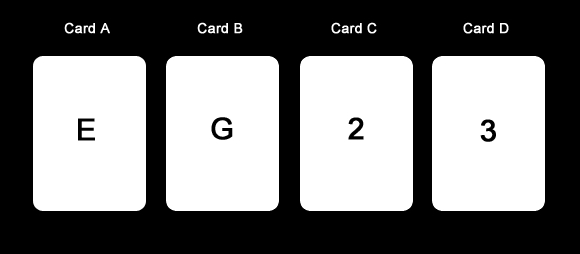
Card Puzzle

FACT: Each card has a number on one side and a letter on the other.

THESIS: Every card that has a vowel on one side has an even number on its opposite side.

REBUTTAL: Which card or cards must you turn over in order to test whether or not the Thesis is true?

Card Puzzle

Write your answer on an index card.

WHY WE CAN’T TURN ALL THE CARDS OVER.
Turning over all the cards is of course a reasonable plan, but it’s forbidden by the challenge of the puzzle, which asks “Which card or cards MUST you turn over?”

WHY WE MUST TURN OVER CARD A
The Thesis states specifically that “every card that has a vowel on one side has an even number on its opposite side.” To test that thesis, we MUST turn over card A. Anything other than an even number would refute the thesis.

WHY WE CAN IGNORE CARD B
The Thesis says nothing about consonants. Nothing on the other side of card B could prove or refute the thesis.

WHY WE CAN IGNORE CARD C
The Thesis says nothing about what’s on the other side of an even-numbered card. Yes, a vowel on one side requires an even number on the other; but an even number places no obligation on the other side. Does an even number together with a consonant refute the Thesis? No.

WHY WE MUST TURN OVER CARD D
A vowel on the other side of card D would refute the Thesis.

WHAT CARD OR CARDS MUST YOU TURN OVER?
<strong>A and D.</strong>
Only 4% of test subjects answer correctly.

WHY WE’RE FOOLED BY THE PUZZLE
—First, we’re desperate for symmetry. When someone tells us all vowel cards are even, we automatically conclude that all even cards are vowels. We’re wrong, but it happens.

—Second, we mistakenly believe that supportive examples prove a Thesis, but they don’t, at least not a Thesis that makes a categorical claim such as “Every card.” No number of supportive cards can prove such a Thesis, but a single exception can refute it.

—”Every clover has three leaves” is not proved by millions of three-leaf clovers, but it is refuted by a single four-leaf clover.

—On the other hand, the fix is easy: “Every clover has at least three leaves.”

Posted in David Hodges, davidbdale, Professor Post, Riddles | 18 Comments

Rebuttal Argument- thatdude

The Great Importance Of The Marshmallow Test

Life throws challenges at a single person everyday, but with the help of self-control we can accomplish these problems. There are not a lot of test that can explore a person’s ability to resist temptation, but the Marshmallow test certainly does.  Dr. Walter Mischel states that the results show a child’s strength  to control its impulses when confronted with a stressful situation. By the child not eating the treat and showing techniques to delay gratification, a reflection of how he or she will act later on in life in a stressful, is shown”I was watching this miracle that occurs when our kids … really begin spontaneously to show dramatic changes in their ability to control their impulses,”This seems logical and accurate opposed to other theories from scientists stating “longitudinal studies show is that children who come from an environment where they have learned to be more trusting have better life outcomes”. This theory is illogical because children grow up in all different environments that have opposing types of living styles which conflicts with their everyday reasoning. For example a child whom comes from a suburban community might trust others because his environment is small and everyone in his community is trustworthy. While a child from an urban community choses to trust few people because of the lack of trust in his large environment. It all depends on how your child is raised and the influence of its environment when it comes to how easily someone will trust another, not a marshmallow test. This would simply  be the wrong test for trust issues unless you pick children from the same neighborhood or community.

This is important for a parent to know so a child can achieve help to gain  self-control “I realized that I didn’t have a clue about what was going on in my children’s heads that allowed these changes to occur and that’s what I wanted to understand.”. With a parent having their child placed into programs that build up his her ability to control their impulses they are easy placing him on better path to succeed in life. Now it is helpful for a parent to realize this problem ,but it is vital for a child to realize also. Once a child can realize how to delay gratification the sooner he or she is  on a better track to succeed. results show the children who had enough self-control to not eat the first treat had higher grades, were not as addictive, and also were able to hold down more jobs compared to the children whom eaten the treat.

Work Cited

Elharo. “A New Interpretation of the Marshmallow Test.” – Less Wrong. N.p., 05 July 2013. Web. 02 Mar. 2015.

Hadad, Chuck. “What the ‘marshmallow Test’ Can Teach You about Your Kids – CNN.com.’ CNN. Cable News Network, 22 Dec.2014. Web. 02 Mar. 2015.

Posted in X Archive | Leave a comment

Rebuttal argument– CasperTheGhost

The Mercy of Euthanasia

In the article “THOU SHALT NOT KILL”: A CASE AGAINST ACTIVE EUTHANASIA, It describes two different ‘types’ of euthanasia. The first, they describe as passive euthanasia, which is when futile treatment is withheld from a patient, and letting them die.  The second, active euthanasia, is what most people thing of when mentioning euthanasia, the termination of ones life through medicine.  Passive euthanasia is a common and legal practice in hospitals, my own grandfather being an example of such things happening.  Active euthanasia, one the other hand, is widely disputed and illegal across most of the United States.

In the article,  it argues that there is a big ethical difference between the two.  They do not refer to active euthanasia as euthanasia at all, they simply refer to it as killing.  “…the intention is different: killing involves a direct intention to cause death, whereas letting die carries an intention to avoid suffering from futile treatment and to let the underlying disease take its course.”  They talk of euthanasia as if it is blind murder, when it is nothing like that.  “Letting someone die” can lead to more suffering and complications then euthanasia.  The passive route involves having the patient sit around and wait for the disease to take them.  This can be more cruel then putting that person to sleep.  Euthanasia is not immoral, it gives the patient control over their lives, over their disease.  The article says that euthanasia is active, referring to actively killing the patient. In truth, it is active, but more that the patient is actively taking control over the disease, and not letting the disease control the patient.

Work cited

Hui, Edwin, and W. BENTON Gibbard. “”THOU SHALT NOT KILL”: A CASE AGAINST ACTIVE EUTHANASIA.” Humanehealthcare.net. 2 Nov. 2010. Web. 29 Mar. 2015. <http://www.humanehealthcare.com/Article.asp?art_id=457>.

Posted in X Archive | Leave a comment

Rebuttal Argument – Albert

Paying for the Mistakes of Others

The constitution of a land should not suffer any violation as long as amendments of such constitution are not made. Fabian Del Orbe implies that, in the Dominican Republic, “ ignoring an existing law, does not free the duty and obligation to fulfill it.” However, Del Orber fails to address that the government is responsible that the constitution is not being neglected. In 1929 a new amendment to the Dominican Constitution was made, which stated that in order to be a Dominican at least one parent had to be Dominican regardless where the baby was born. Nonetheless, after stating who was Dominican in the constitution, the government kept giving documentation to anyone born in the country of undocumented parents. Many Dominicans of international descendent, which parents without documents thought that giving birth to them in the Dominican Republic automatically provided Dominican citizenship to their children, now are being considered “stateless” by the sentence TC 0168-13. Denationalized citizens face lack of opportunities and deportation to their ancestral native country because by law they were never Dominicans. Now, jobs, education, health insurance, getting married, the right of ownership are privileges taken away.

Of course the constitution of a country has to be followed as it dictates; nonetheless, the nationality of the place we were born and raised seems as a right we should all have. The people should not suffer the consequences when the government of a country does not follow the constitution. As an excuse, the Dominican government in 2014 came with the law 169/14, which “provides for special arrangements for people born in the country, entered illegally in the Dominican civil registration and naturalization.” because “ the Constitutional Court showed a deficiency of the Dominican State that lasted over time and spread throughout the country, which caused a number of people born in the Dominican Republic received the Dominican State’s own documentation that made presume that was Dominican nationals,” after 1929, “based on which developed their civil life with certainties and specific expectations based on that condition.”

If the Dominican government had initially followed the Dominican constitution, now the children and grand children of any undocumented parents, who migrated to the Dominican Republic after 1929, would not be facing deportation and lost of their Dominican nationality. Orbe brings a good argument by implying that the ignorance of the law does not justify its violation. Nonetheless, if who are responsible to maintain the law failed, we cannot make people who were victims of the negligence of the Dominican government pay. A law like the 169/14 is not the way of fixing the life of the victims, time to fix the nationality is not needed, but the nationality that was once given by the government.

Works Cited

Del Orbe, Fabian. “Re: Mi Opinión Resumida En El Caso De La Sentencia 168-13, Del Tribunal Constitucional.” Web log comment. Francomacorisanos, 23 Oct. 2013. Web. 28 Mar. 2014. <http://www.francomacorisanos.com/VerNoticias.aspx?ID=27931&Imagenes=Imagenes/Noticias/haitianosfrentealcongreso.jpg#.VRd8_JPF_K0>.

“Ley No. 169-14.” El Congreso Nacional En Nombre De La Republica Dominicana (2014): 1-2. Web. 28 Mar. 2015. <http://www.consultoria.gob.do/spaw2/uploads/files/Ley%20No.%20169-14.pdf>. <span>Law establishing a special scheme for people born in the country registered irregularly in the Dominican Civil Registry and naturalization .</span>

Mendez, Wanda. “Ley 169/14.” Listindiario.com. Listin Diario, 31 Dec. 2014. Web. 28 Mar. 2015. <http://www.listindiario.com/puntos-de-vista/2014/12/30/350985/Ley-16914>.

Posted in X Archive | 2 Comments