Causal Argument- taddo

Addicts have a hard time getting through their day to day lives. Heroin is a dangerous and addictive drug, and once a person becomes addicted, there is very little to do for them. Addicts struggle to maintain jobs with steady incomes, because of the fact they are using. They also have a difficult time keeping relationships and making them last. When it comes to heroin, or any drug really, once a person becomes addicted, they will do whatever they have to do to get their hands on the drug. These people commit crimes like stealing or breaking and entering. For addicts, they will do as much as steal from a stranger on the street, to stealing from their own family in the safety of their own home. What Vancouver is doing is not supposed to ween these people off of using heroin, they know that is not going to happen. The point of what this city is trying to accomplish is really to save their city. They want to get these addicts off the street so they stop committing petty street crimes and keep them out of the hospital as well. These people use bad drugs or unsanitary needles and find themselves in the hospital facing hospital bills they just can not afford to pay. They allow these people to receive free heroin and receive it in the cleanest way possible. This is not going to fix the addiction that these people face, but it will help fix the city that they live in.

Posted in X Archive | 3 Comments

Causal Argument- Hashmeesh

Insite Doesn’t Lead To Detox

Normally when clinics offer treatment for heroin addicts they try to get them to stop using and become clean. A person couldn’t possibly be treated if they were still using, it would defeat the whole purpose of the treatment. Vancouver thinks the complete opposite. Clinics in Vancouver offer heroin addicts free heroin. The clinics claim that by giving them heroin they are keeping them off the street and keep them from getting bad drugs or AIDs.  The addicts have a choice whether to go to a detox center or not, if not they can get free heroin for life. They are just sustain their addiction. Vancouver sees the treatment more as way to lower the crime rate.

Work cited

“Vancouver Combats Heroin by Giving Its Addicts the Best Smack in the World.” Public Radio International. N.p., n.d. Web. 06 Apr. 2015. <http://www.pri.org/stories/2015-02-04/vancouver-combats-heroin-giving-its-addicts-best-smack-world&gt;.

Posted in X Archive | Leave a comment

Causal Argument — Cyphercomp2

“As the Human Race Innovates, It Defies Natural Selection”

In a darkly practical sense innovation in technology is a sped up means of death biologically if we are to believe natural selection to be inherent. I feel that innovation is a good thing, but it challenges our concept of evolution and natural selection. All of innovation’s purposes are to bring pleasure. It doesn’t matter if it is a lollipop a form of dance or a nuclear bomb, someone will always receive some form of pleasure from it. The pleasure can range from a relief or to a gain, but in the end it will still kill them. Innovation in every sense through a ripple effect is meant to bring pleasure which is supposed to both compensate and also endlessly fight the death that it causes for itself. Though this idea which opposes common logic, and rightfully so, can be applied virtually anywhere in history, the 1800s will be where this argument will start. The very first industrialized electrical grid was turned on in the year 1882, this was when american’s started killing themselves at a higher pace via electrically boosted innovation. Electricity has made life awesome, but at a cost. There are six general sectors of life that will be focused on here, entertainment, health, energy, transportation, information processing and cultural/social aspects all having something to do with innovation and it’s theoretical dealing of death.

Entertainment has been greatly influenced by innovation and electricity. The human race has gone from puppet shows on the side of the road to IMAX movies and virtual reality video games that blur the boundaries of fact and fiction. But, sadly, entertainment and its innovation cannot come without a heavy price. Almost all of innovative entertainment does not involve very much physical activity, but it does involve a lot of sitting and gazing. The american national average for hours of video games played in a week on the low end is 22 hours as of 2014. Video games have proven continually to cause poor posture in gamers as the usual stance is hunched over for long periods of time. This generational wave of bad posture causes muscle stiffness in the back, the upper neck and the eyes. In the back, arching can occur that is almost impossible to reverse without great measures being taken. In the neck, herniated disks can cause permanent forward facing neck posture that if altered, is extremely uncomfortable. The eyes focus on objects at different distances using small muscles to expand and contract. When the eyes focus on screens and static objects for extended periods of time, the strain that is felt is actually a form of eye work out, the only problem is this workout is making the muscles stronger in only one position. This over strengthening of the eye muscles can make different distances blurry. Macular degeneration is a serious problem among repeat computer users.

After thousands of physical ailments are gained by the use of entertainment. The habits formed from that lifestyle translate directly into the health sector of life. At home, Americans have diets that reflect a lot about themselves. Those who are very much into being entertained often spend more money on snack foods that have decreased nutritional value and plenty of sugar. A 2 liter bottle of Mountain Dew is not an uncommon ornament in a gamers lair. The absolutely horrid diet that emerges from a lifestyle bound to entertainment translates into serious profit for the medical industry. As more and more people seek professional, innovative medical assistance more and more symptoms are subdued and even cured. The problem is that the mindsets of these people have not changed from problem causing to problem preventing ones. So, while those who have nearly died or technically should be under their conditions remain in a medicated state, the less likely the next generation is to be much different than them. The negative impacts that inherited mindsets and habits have on the next generation compound much like money in a bank. So as the elderly unchanged in habit continue to remain living on medical innovations that simply keep them alive only to use “merciful euthanasia” in the end continue to grow in numbers, the young deplete. There is a shift called a “demographic winter” that occurs when the population of the elderly exceeds the population of the young, it is very difficult for the young supporting the elderly who cannot support themselves, to start families and produce the next generation. So, in short, innovation in the entertainment industry lands lives into a dependent state in the medical industry. Those in the medical industries registry of dependents rely on the very thing that got them there, innovation.

Once entertainment, and medication create dependently weak generations who can neither support themselves nor the previous ones, energy begins to be a serous concern. As if innovation has not already produced amazing forms of energy production already, society will eventually reach a point that energy production will require almost no effort at all. Going from splitting wood, to coal and then nuclear power plants has demonstrated the lengths human beings will go to shed a little light and warmth on the everyday tasks of life. However, as a side note, consider what the benefits were of the cardio a man or women would receive after splitting wood on a daily basis. Next consider how that small amount of cardio contrasts with flipping a light switch or turning on the stove. While we have medication in the 21st century that can halt the flu and the common cold in their tracks, the average person today is physically less robust and enduring than that of previous generations. The pursuit and finding of simple and easier energy solutions causes major ripple effects in the amount of energy and therfore the amount of small gains the human body receives from doing things. There is a ripple effect that protrudes from every action an individual and a generation takes.

Along with energy production and its many alterations to a generations destination, transportation methods are also changing and the people along with them. Though the lack of sunlight may be unhealthy, in large cities where many people opt for bikes instead of cars, consider the health benefits. As electric cars become a reality, and all of the pleasing luxuries along with them, health rates will decline. Don’t get me wrong, electric cars are amazing and are in no way worse than conventional automobiles. However As an illustration, as transportation becomes more innovated, the level of human output and thus human health benefit depletes dramatically. After a movie and corndogs it is not normal to go for a 5 mile jog. After spending 10 years getting the same machine coffee before work with the same breakfast sandwich, it is difficult to switch the habit over to a healthier alternative. Similarly, the habits formed in a generation and in an individual after each innovative change in each sector of life, are very difficult to deviate from.

When society is in a steady state, a state in which all of its survival needs are readily met, it begins to focus on things like innovating the way it learns. Information processing is a big deal in the 21st century, but who is doing the processing? Just like a bank account compounding with interest, innovation does the same. When calculators were introduced in bulk to elementary schools children retained math differently, no longer did they have to remember times tables to the fullest extent. Now those children could calculate things they had never been able to before, but they lacked the mental historical record of how they got there. I experienced this immensely all through grade school and it has hindered me up until I was nearly 17. In 4th grade my classmates and I were given calculators and we never once had to memorize times tables, we spent a few weeks learning how to do the functions of math on paper and thats it. The ripple effects of not being able to do things without aid are not so much of a problem until the aid disappears. Information processing in relation to innovation and how they hinder mankind are relatable to foreign aid. A country has just been saved from dictatorship and a serious earthquake that has caused death leading to diseases  and cultural meltdown. While under dictatorship the people were not “in the know” and could not control any aspect of life without those “in the know” approving it. Now they are free but do not know how to take care of themselves. Technological innovation is an addicting and pleasurable dictator that causes death while it is depended on, but also when it is missing. There is a very delicate balance between innovation and death that may never be understood.

If our understanding of natural selection is true then innovation is a problem. There are many causes for innovation leading to death (according to natural selection), human beings are inherently smart and will always seek to make things easier and more attainable. But the easier the lifestyle passed down becomes, the weaker and less motivated the next generation will be. Innovation is a two edged sword. The weak are not a problem, the sick are not a problem, the innovation that cannot be changed that will eventually lead up to struggles is a problem.

Leave a comment

Casual Essay–tagfcomp2

“Forgetting memories isn’t always a bad thing”

We have all experienced a time when we’re trying to remember something and can’t recall the memory or specific details we’re looking for. Although these memory blocking moments may seem like a nuisance, memory actually works in favor of us. If people were able to remember every detail and feeling associated with an event, we wouldn’t experience many things twice.

If you were to ask a woman what child birth felt like, she might describe the experience as the most painful moment of her life. The soreness after birth, may remind a woman of the pain she went through during her hours of labor. However, as time goes by, the memories of a painful childbirth begin to be forgotten. Therefore, a woman may want more children. If a woman was able to remember every moment of childbirth and the pain associated with the process, she may not want a child again. If we weren’t able to forget painful memories, we wouldn’t be as willing to experience memories again that may end painfully. Our memory shields us from everlasting unpleasant feelings by fading away details of an event.

Work Cited

Hammond, Claudia. “Why Painful Memories Linger with Us.” Future. BBC, 12 Mar. 2015. Web. 6 Apr. 2015. <http://www.bbc.com/future/story/20150311-can-we-edit-out-painful-memories&gt;.

Posted in X Archive | 1 Comment

Agenda MON APR 06

  • Open your My Notes
    • Post the comment: “Attended Class.”
    • Close your My Notes
  • Welcome Professor Jude Miller
  • LectureMy Counterintuitive Weekend
    • Make running notes as a Reply to the post.
  • LectureThe Opposite of a Black Sneaker
    • Make running notes as a Reply to the post
  • Demonstration/ExerciseJust Passed Scenic Views
    • Improve the bad quotation techniques in a Reply to the post.
    • If not completed in class, finish as homework.
Posted in Agendas, David Hodges, davidbdale, Professor Post | 2 Comments

Scenic Views

The Right Time to Quote

Suppose we have an argument that’s difficult to prove, and evidence is scarce, but we do have one good quote that clearly demonstrates the validity of our position. Suppose also that the quote isn’t entirely unambiguous and allows for interpretation. We want our readers to hear the supportive spin, but resistant readers might hear the ambiguity instead.

We have to use the quote when our readers are prepared to hear it correctly.

We cannot trust our readers to hear the quote in its proper context without preparation. We need to make them ready. Here is the sequence:

  1. Tell readers the value of the quotation.
  2. Certify the reliability of the source.
  3. Eliminate ambiguity by interpreting the quote in advance.
  4. Offer up the quote.

.

How Often Do We Do This?

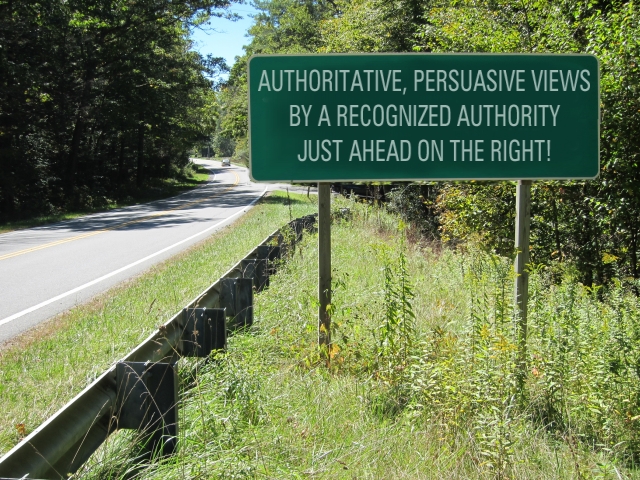
just-passed-scenic-views.

Readers are notoriously distractable. They pay attention only when they’re seduced or coerced. Like highway drivers who fail to notice the breathtaking scenery because they were fiddling with their iPhones or following their GPS screens, our readers can easily miss our most persuasive arguments because we didn’t first capture their attention.

We want them reading that quote to confirm what we’ve already told them. If they miss it, we’re unlikely to get another chance. And if they read it before we tell them what it means, they will draw their own conclusions, and no amount of explaining afterwards will convince them to change their minds.

When We Should be Doing This!

Scenic Views 2

Examples


Hurricane Sandy (1)
(Red is the view. Green should prepare us.)

“Although it took only a matter of hours for Hurricane Sandy to cause widespread damage throughout the region, recovering from the second costliest hurricane in U.S. history and improving coastal storm damage risk reduction will be a long and complex task,” said Brigadier General Kent D. Savre. Savre is the commander of the U.S Army Corps of Engineers, North Atlantic Division. He had an enormous weight on his shoulders in this situation, being that he is the commander of the U.S Army Corps of Engineers, zoned for the region that took the worst hit from Hurricane Sandy.

Hurricane Sandy (1) Improved
(Blue is the best sequence for the argument.)

Brigadier General Kent D. Savre saw the worst of Hurricane Sandy, and he knows the cleanup will last for years. As commander of the U.S Army Corps of Engineers, North Atlantic Division, he warns that although Sandy devastated his region in just a few hours, “recovering from the second costliest hurricane in U.S. history and improving coastal storm damage risk reduction will be a long and complex task.


Hurricane Sandy (2)
(Red is the view. Green should prepare us.)

As of last month, the Corps was involved with over 200 projects and studies all down the East Coast, and as far inland as Ohio. The Army Corps is devoting enormous effort to not just reclaiming, but improving the beachfronts against future storms with projects centered around river navigation, and protection from storms by implementing levees, sea walls, and breakwaters. This is a quintessential example of both unifying, learning from past mistakes, and preparing for the future catastrophes.

Hurricane Sandy (2) Improved
(Blue is the best sequence for the argument.)

While recovery can be prompt, learning from past mistakes and improving the infrastructure to prevent future catastrophes requires study, time, and lots of money. The Corps is currently conducting 200 projects and studies. As far inland as Ohio, they’re repairing storm damage; along the East Coast, in addition to reclaiming, they’re building vastly expensive new levees, seawalls, and breakwaters to protect beachfronts from future storms and improve river navigation.


Hurricane Sandy (3)
(Red is the view. Green should prepare us.)

Savre later stated: “Please keep in mind that regardless of how many storm damage risk reduction features are put into place or how high, wide or strong they are constructed, there will always be residual risk. There is always the potential for an even bigger storm. We need your help to ensure residents fully understand the risk and plan accordingly.” Learning from the past and preparing for the future are the two most vital things when it comes to restoring an area amidst catastrophe, and Kent D. Savre concurs with this notion.

Hurricane Sandy (3) Improved
(Blue is the best sequence for the argument.)

Savre knows it’s impossible to eliminate risk no matter how much money is spent. Regardless of the number of “storm damage risk reduction features” the Corps construct, there will always be “the potential for an even bigger storm” than the one we learned from last time. “We need your help to ensure residents fully understand the risk and plan accordingly,” he said.


In-Class Exercise

Several more examples of “Just Passed Scenic Views” require your corrections. Name them and correct them in the Reply field below. You don’t have to reprint the uncorrected paragraphs, just your corrected versions.

Nancy Pelosi
(Red is the view. Green should prepare us.)

A year after the storm, Nancy Pelosi, the minority leader of the United States House of Representatives, said, “A year ago, Hurricane Sandy wreaked havoc on communities up and down the East Coast. We saw homes destroyed, businesses leveled, and lives lost. Today, we hold the memory of those 117 Americans in our hearts, and offer our thoughts and prayers to the loved ones they left behind. Hurricane Sandy reminds us that when disaster strikes, Congress has a responsibility to help the victims pick up the pieces. American families deserve to know that their government will be there for them, without question and without hesitation.” Pelosi made it clear that she understands the government, and that means all the municipalities along the East Coast including the federal government, have a responsibility to the victims of the storm, as she stated in a speech made on the one-year anniversary of Hurricane Sandy, even though much of the area is still devastated and thousands of people haven’t gotten back into their homes.

Indian Rapists
(Red is the view. Green should prepare us.)

A majority of Indian rapists come from low income slums; they are commonly divorced and alone. This is not to say that all poor men are rapists or vice versa. In her article “The Good Men of India,” Lavanya Sankaran points out that India is “awash with feral men, untethered from their distant villages, divorced from family and social structure, fighting poverty, exhausted, denied access to regular female companionship, adrift on powerful tides of alcohol and violent pornography.” Considering she is an Indian woman, it is incredible how Sankaran can sympathize with these criminals. The underprivileged Indian male community do not hold the right to rape women just because they have been “divorced from family and social structure” and “denied access to regular female companionship,” yet somehow Sankaran manages to consider their loneliness and isolation to be mitigating circumstances.

Kyleigh’s Law
(Red is the view. Green should prepare us.)

Teens aren’t the only ones who don’t support Kyleigh’s law. While some police officers strictly enforce it, many don’t believe in it. I asked two New Jersey police officers about their opinion of the law. A former Atlantic City police officer, Steven Cupani believed the law to be ineffective, and a waste of time. He stated, “It’s a waste of time. Kids don’t like the law, but it is not going away so they better buy the decals.” A detective sergeant in the Somerville Police Department, Kenneth DeCicco believes while the law meant well, it wasn’t properly done and can have adverse affects. “Lawmakers were trying to react to a tragic social event. The law has good intentions but was not well thought out. It has the potential for the opposite effect, because it identifies underage kids. There is no legit effect to keep drivers safer either.” As a teenage driver, I do not believe in the decals, and do not use them on my car. My parents don’t believe in them, and many of my teenage friends also do not use them. The decals identify drivers as youthful and make them the target of possible stalkers or criminal mischief, so many teens are reluctant to display them, and their parents often agree. Cops think they are probably a political gimmick.

Barnegat Bay
(Red is the view. Green should prepare us.)

The Barnegat Bay in New Jersey is seen by the EPA as one of the most polluted coastal waters in the country. This shows that New Jersey clearly has some issues in concern to the water. In the Barnegat Bay specifically, there have been an invasion of jellyfish due to a 100-mile algae bloom floating in the shore. The alga has bloomed due to pollution. So, with all of the jellyfish in the bay it is less functional. Unfortunately the bay is not the only water source suffering. More then 100 beach closings have occurred annually. The current laws need to be changed in order for pollution to stop spreading in the shore.

Filter Bubbles
(Red is the view. Green should prepare us.)

The effect of filter bubbles, which censor search results by trying to predict what a particular computer user is interested in, can be witnessed in the simplest of web searches. Two friends recently searched the term “Egypt” on Google, using computers that knew their search history, and got completely different results; one consisting of political articles about resistance movements, while the other did not include any stories of the protests. Evidence such as this illustrates the extremely serious threat filter bubbles are causing online today. If Google tracks our search history, it will know whether we search for political stories, or try to find travel destinations like Egypt, and it will filter our results as the example shows. That changes our experience of using the web.

The Shutdown
(Red is the view. Green should prepare us.)

The Government Shutdown has affected more than just the government employees. WWII and Vietnam veterans were denied access to war memorials. That is an absolutely uncalled for action by the US Government to deny veterans the opportunity to honor their brothers.

The shut down is inconveniencing civilians who are living  paycheck to paycheck like Sheila Caraway. She was turned away by a guard at the IRS when she tried to get her tax refund to pay her bills. People like Sheila  spiral into debt and lose their ability to pay their bills.

Haiyan Wang, a Chinese tourist denied access to the Statue of Liberty, was disillusioned by America’s dysfunction. “The Chinese government never closes down.” America is now a joke in the international world. The ruling parties are at odds with each other and cannot agree on a single issue. This, in turn, affects America’s reputation in the world. 

Bad Jokes
(Figure out the best sequence for yourself.)

Children suffer excessively harsh consequences for making tasteless and/or threatening jokes on Facebook and other social media sites. California governor Jerry Brown, has just passed a bill that could help the situation. This is how Justin Carter from Texas was put behind bars in February for a Facebook post taken way beyond its real meaning. Some, including him, have also suffered painfully by being beat up and put in confinement for weeks on end. Bad jokes shouldn’t land our kids in jail. The bill will allow minors on Facebook, Twitter, and other networking sites to permanently delete content at their request. This will allow some to stay out of trouble, and others to get a fresh start if they are applying for a job or college. Prior to this bill being passed, posts and pictures were  really just hidden and police and other officials were able to track it down.

Teacher Gender
(Figure out the best sequence for yourself.)

In an article about teacher gender by ABC News Chicago, Michael Glascoe, superintendent of schools in Paterson, New Jersey, states: “It’s the teacher — you can have same-sex classes, you can do that, but it’s the teacher. Cause you can have a terrible teacher takes that on, and it’s not going to work. It has to be someone, and I say this over and over, who can engage the hearts of the students. You got to have that heart for the children and their well-being, and really push that. The great teachers do that.” Meaning that the teacher’s heart plays a much bigger role in the student’s learning than their gender.

Posted in David Hodges, davidbdale, Professor Post, Writing Lessons | 25 Comments

The Opposite of a Black Sneaker

In Favor of Outrageous Thinking

The goal of all our arguments is not to join a black-or-white debate, but to create a color, or a set of fancy footwear, not the comfortable shoes that “go with everything,” but a pair of high-heeled neon ankle-killing athletic shoes everyone laughs at until the day she buys a pair. If you start with black, and I start with white, we tend to think we should meet somewhere in the middle, and the middle too often looks gray. BlackWhiteGray Gray satisfies no one. It can’t be what we wanted. Ending up with compromises no more compelling than our starting premises wastes our readers’ time (if we still have readers at the end). Instead we need to realize we’ve misinterpreted our starting points. We haven’t started with opposites. For one thing, we’re both talking about sneakers.

The opposite of a black sneaker

The opposite of a black sneaker isn’t a white sneaker; it’s broccoli, or impressionist art, or the atomic weight of laughter. We’re not obligated to compromise our positions to find something that contains components of both. We should instead be hoping that the tension between the two ends of the spectrum reveals something more interesting than either of the “sides.” First it reveals that we haven’t started on the two extremes. Then we discover there’s something beyond both our positions. BlackWhiteRed

Gray on Gray.

The worst mistake we can make—even worse than settling for gray—is to start with gray, which can only result in more gray. GraySneakers

Gray on Gray, A Model:

The most common misconception with someone who is happy is we think that person has meaning in his life. A person who is happier may even have less meaning in her life than her less-happy counterparts. Happiness doesn’t define meaning; rather, it defines contentment. Having meaning in one’s life runs deeper than the mere sensation that happiness brings. Meaning is about contributing to the world, to something greater than oneself. Happiness is just satisfaction with one’s current standpoint on life, and one’s environment. The world defines happiness as something much greater than it actually is. Happiness is nothing more than the satisfaction of one’s current standpoint.

Color on Color.

Our goal is the colorful conclusion, achieved by beginning with bold and colorful premises, somewhere along a line of reasoning the ends of which are not in sight when we begin. BlackWhiteWings

Color on Color: A Model

Our neighbor Frank seems happy, and would probably define himself as happy, but he’s not. He takes pride in his fine house, where he lives with his presentable family, and he has job security. Let’s call him content. Our neighbor Ernest rents a cramped apartment, lives alone, and scrapes by freelancing. Let’s call him happy. Ernest is tortured by an abiding outrage against injustice. He champions every cause that comes his way if it will better the world or ease the suffering of others. Often hungry himself, he will share his lunch with anyone. We might prefer to be Frank, but Ernest is more likely to be happy.

If you can prove that, I’ll eat my shoe.

The result of our premises will not be as certain as when we try to start with supposed “opposite sides” of a known argument, but the pursuit of an outcome will be more entertaining, vivid, colorful, and compelling. Maybe even nutritious. SneakersBroccoli

Posted in Counterintuitive Topics, David Hodges, davidbdale, Professor Post, Writing Lessons | 17 Comments

My Counterintuitive Weekend

Counterintuitive Weekend

Now that we’ve passed the halfway point of the course and you’ve completed your short arguments, you’ll be trying to find a way to massage all your material into a fresh and compelling—with any luck counterintuitive!—argument. This feels like a good time to refresh your understanding of counterintuitivity.

I haven’t always had an outlet for my particular slant on life. A some point in Catholic grade school I started to wonder if maybe God was made in man’s image instead of the other way around.

Maybe because we can’t comprehend eternity, we call eternity God. And because we can’t comprehend infinite space without bounds, we call the limitless universe God. We can’t accept the lack of justice on earth, so we imagine heaven where the scales are all balanced. If so, God doesn’t answer resolve the incomprehensibility of anything; deity is just a way to phrase our unanswerable questions.

What we believe to be the case is probably not. Call this a scientific way of thinking. Every conclusion, as soon as it’s proven, is subject to fresh dispute. That may sound like despair, or it can sound like progress.

Running errands this weekend, often with the radio on in the background, I had some counterintuitive thoughts.

  • Facebook has more gender categories than the Olympics

Have you heard about this? Instead of forcing users to identify as merely male or female, Facebook has introduced a third massive category of “custom” gender options including “transgender,” “cisgender,” “gender fluid,” “intersex,” and “neither.”

I don’t know whether this will solve or further complicate a problem social media has always had of not knowing what to call us when they recommend us to others. You’ve probably noticed oddities such as, “David Hodges would like you to view their page.” Maybe now that I can choose my gender more specifically, they won’t be so squeamish about calling me “he.”

I heard this news while thinking about Olympic athletes from now and ages ago whose genders created questions or disputes. Chinese gymnasts of earlier games are thought to have been as young as 12 or 13 (girls, not women; not exactly a gender problem, but a category problem). Also loudly whispered was the question: were the 14- and 15-year-old competitors fed hormones to delay their advancing development from girlhood to womanhood?

On the other extreme, were Russian athletes in strength competitions actually genetic gentlemen competing against the ladies, or again steroid-fed women whose physiques were artificially masculine?

Now finally, there are some women competing in bobsled contests, but still the gender divide is fairly complete: Men’s Downhill, and Women’s Downhill. How long can these binary categories last when in the rest of our lives we’re invited to be more selective in which gender we “present” to the world?

My Shopping List is an Argument

I hope I’ve told you once, and I will certainly tell you again, that every written document is an argument. I challenge students with this premise all the time because it sounds so implausible, but I’d like to present a shopping list as an example of what I believe to be a written argument, written for a particular audience, which becomes a battleground for dispute in the hands of any other reader.

Shopping List

As long as I (the intended audience) have this list with me, my reader is unlikely to argue with its premises. But even so, I may decide to substitute Haagen-Dasz for Breyers if the price is right. But if my wife takes the list to the store on my behalf she may present compelling counterarguments to my “essay” on the following grounds or others:

  1. Who needs premium ice cream?
  2. Will he ever notice the difference between conventional kale and organic kale (Is there actually a difference?)?
  3. We already have plenty of drawstring bags.
  4. We don’t have room for 24 more seltzer bottles.
  5. Since when do we buy beef specifically for the dogs?
  6. Even if the per-pill price is significantly cheaper, I can’t believe we’ll use 1000 ibuprofen before their effectiveness expires.

Diarists Lie

On this topic, please remind me to argue that a diary is written for a very specific audience and therefore is as manipulative and artificial as any other piece of writing. (If you need a preview of this demonstration I will direct you to Francine Prose’s wonderful examination of Anne Frank’s Diary of a Young Girl, which, she argues convincingly, was extensively edited by Frank for the sake of future readers.)

Mitt’s Audience

On this topic also, I could share with you the video captured at Mitt Romney’s campaign fundraiser during the runup to the 2012 presidential election. If you can imagine him making the same speech to any other audience, then you haven’t started thinking seriously about how exactly we craft what we write to suit our intended readers.

Link to the speech.

Duchamp’s Readymades

Marcel Duchamp is a favorite of mine, and I’d recently been to the Philadelphia Museum of Art, so when I found myself handling paring knives and graters in the kitchen, I asked myself the simple question: is this item art?

cheese grater

It’s certainly beautifully designed and crafted, but my instinct tells me its functionality prevents it from being art. My working definition is that art is something created for no other purpose than to be observed or experienced. Still, I’m disputatious, so I didn’t let that first impression stop me. It certainly didn’t stop Duchamp from calling this art:

bottle_rack

He didn’t create it, design it, weld it, or change it in any way except to sign it and remove it from the place where it would have had a function. Placing it into an art gallery, for Duchamp, and for the rest of the art world, effectively transformed a wire bottle rack into a piece of art. So maybe my definition still works. Maybe not. Do you have a better definition for art you could pursue as a counterintuitive topic?

Tim’s Vermeer

While I was puzzling over ready-mades and washing dishes, I was reminded that I hadn’t yet seen a documentary that had been on my list.

The Dutch painter Vermeer is well-known for his remarkably realistic interiors in which people and furniture are carefully arranged. He handled perspective perfectly, long before other painters had a clue how to realistically portray actual items in space.

Vermeer Music Lesson

Inventor Tim Jenison thought he might have an idea how Vermeer accomplished his remarkable achievement. He knew, as many did, that pinhole cameras had been used by artists for years to project images onto walls for reproduction.
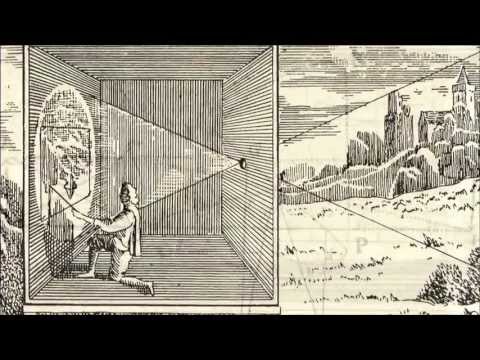
Pinhole Camera

Jenison is an inventor, not a painter, so he wondered more about how such a “machine” might help him accomplish a job than about whether the result would be art. This early question eventually led him to discover that he too could accomplish remarkably “artistic” results through mostly mechanical means. First, he built a room like the room in Vermeer’s “Music Lesson.”

Vermeer's Room

Then, he dressed models in appropriate clothing.

Vermeer's Music Tutor

Then, using mirrors to reflect images of the room just in front of his canvas, he mixed paints to match what he saw before him, and, without any artistic training, he produced facsimiles of the images he placed before the mirrors.

Link to the video

After years of practice, trial, error, and corrections, he has upset a lot of people by painting this:

Finished Vermeer

One More About Art

Alexa Meade has a different way of representing three-dimensional objects as two-dimensional objects. She paints directly on the objects, turning them from objects into paintings.

This isn’t a painting of breakfast. It’s breakfast, painted.

breakfast

And this is not a painting of a man on a bus. It’s a man on a bus, painted.

Man on Bus

Here’s how it looks when she’s working on it.

Painted+Installations

Here’s how it looks when other people look at it:

At the installation

Let’s apply a different way of thinking to some real-life social and ethical issues.

Bariatric Surgery

Do you have a strong feeling about bariatric surgery? I don’t. I’m sympathetic toward people who can’t seem to keep their weight under control despite their best efforts. I’ve conducted enough skirmishes with my own body to appreciate that our appetites are not merely hungers we can control with “will power.”

I also don’t think “will power” is a commodity we all have access to in the same supply. So a person whose body conspires to withhold every calorie, who also lacks the psychological ability to deny himself, or the physiological signal that tells the rest of us we’re “full,” is just cursed and needs some help.

So, why does this story from the Wall Street Journal disturb me so much?

“As the World’s Kids Get Fatter, Doctors Turn to the Knife.”

BariatricSurgery

Daifailluh al-Bugami, 3 years old, is awaiting bariatric surgery. Daifailluh is among a rapidly growing number of kids in Saudi Arabia undergoing radical surgery to control their weight. In the last seven years, Daifailluh’s doctor has performed bariatric surgery on nearly 100 children under the age of 14 from countries in the Gulf region.

Euthanasia for Kids

This one you already know about. From the New York Times: “Belgian lawmakers gave final approval on Thursday to a measure that would allow euthanasia for incurably ill children enduring insufferable pain. King Philippe is expected to sign the measure into law and make Belgium the first country to lift all age restrictions on legal, medically induced deaths.

“Under the measure, approved 86 to 44 by the lower house, euthanasia would be permissible for terminally ill children who are close to death, experiencing ‘constant and unbearable suffering’ and can show a ‘capacity of discernment,’ meaning they can demonstrate they understand the consequences of such a choice.”

As you can imagine, despite the majority in the legislature, the prospect of letting kids decide to die, and helping them do so, has some very vehement opponents.

Why do I consider this question counterintuitive? There are more than two points of view here.

  • Some might object to assisted suicide period.
  • Others might insist we all have the right to end our lives if they’ve grown intolerable.
  • Those in the middle might think it’s acceptable for the very elderly to end their lives slightly prematurely but be appalled at the prospect of ending a child’s life.
  • All three points of view are counterintuitive.

What’s counterintuitive about them?

  • We can’t actively promote killing ourselves without feeling the natural resistance of our bodies to preserve themselves.
  • We can’t logically insist that our loved ones continue to suffer after they’ve concluded that their lives are worth more to us than to themselves and very little to either.
  • And if we want to claim that the elderly have a right that is somehow unavailable to youth, let me suggest this:
    • Distance from birth is one way to calculate age; distance from death is another.
    • By the second calculation, the child with the terminal illness is older than you and me.

If you want to change the world . . .

change the metaphors we use to describe it.

Here is a sleeping dog:

Sleeping Dog

But add just two little black dots, and here is what a predator sees when considering whether to attack the “sleeping dog.”

Dog Awake2

Now that you’ve seen the extra set of “eyes” above the dog’s eyes, you can never un-see them. Practice finding that in your arguments. Give your readers a perspective they can never un-read.


Posted in David Hodges, davidbdale, Professor Post, Riddles | 15 Comments

Causal Rewrite – Moneytrees4

Discrepancy of Our Health

Lately, a lot of discrepancy has been surrounding multi-vitamins. This is baffling seeing how these supplements have been around for so long. Multi-vitamins have been used for such a long time that people completely trust that they will have results. It seems so simple; something is seen on TV that is said to increase overall health, go to the store and purchase it. What could have possibly uncovered the dark side of something so widely accepted for so long?

The answer is research and the data the research has produced. Many researches have been uncovering results from tests that prove multivitamins are ineffective for an already healthy person. This is shocking because they do not seem to help people who could use a more fortified diet either. One may ask how this information has taken so long to get out. Perhaps these supplements started out being helpful but were diluted or changed in order to increase a company profit. This new information has caused the credibility of multivitamin supplements to decrease dramatically.

When something loses credibility, a lot of negative things follow. People will stop investing in the product, stop consuming the product etc. With the case of multivitamins, the research that found these supplements to be useful caused people to view them in an entirely new light. Rightfully so! The companies that produce these products make billions and they do not care less about the ineffectiveness of their product or even the negative effects of them.

Work Cited

Shute, Nancy. “The Case Against Multivitamins Grows Stronger.” NPR. NPR, n.d. Web. 06 Apr. 2015.

Posted in X Archive | 3 Comments

Causal Rewrite 2 – Albert

Everyone Pays

With a single sentence in the law TC 168-13, the Dominican Republic has taken away the nationality of Dominicans of undocumented parents, depriving thousands of Haitians of citizenship. According to the anthropologist doctor Jorge Duany, the sentence is not designed to discriminate anyone; however, its practice does have a major effect in the Haitian population in the Dominican Republic. As in the Dominican Republic the concept that “Haitian immigration affects the wages of the Dominican workers and contributes to increasing levels of poverty in the Dominican Republic” has always been the most used excuse why the Dominican population supports the sentence. However, Caribbean nations react negatively to Dominican Republic’s actions, and so are the Haitians in Haiti.

Caribbean Community (CariCom), which is an organization that provides a partnership with Community institutions and groups in the Caribbean “toward the attainment of a viable, internationally competitive and sustainable Community, with improved quality of life for all,” establishes that only 6.937 Dominicans with Haitians descent could take benefit from the extra time to apply for the Dominican nationality that the Dominican Republic  provided to Dominicans descendants of undocumented parents with the law 169-14. Therefore,  more than 100, 000 people are in danger of deportation to Haiti with the Sentence TC 168-13. As a result, CariCom had decided not to incorporate the Dominican Republic because of the violation of the human rights made by the sentence TC 168-13.

More forward the National Federation of Dominican Transportation (Fenatrado) is experiencing the frustration of the Haitian community towards the sentence. The truck drivers who import products from the Dominican Republic to Haiti have been attacked by Haitian citizens with stones and hard objects thrown to the trucks. The groups of Haitian rebels have overpowered the Haitian soldiers who are responsible for the safety of the truck drivers. Therefore, the truck drivers “will be forced to suspend cargo transport to the neighboring country, until the Haitian and Dominican authorities to agree to guarantee the safety of vehicles, drivers and loads transported;” as a result, Fenatrado is now experiencing the results of the mass- hysteria caused by the sentence.

The Sentence is not only affecting the Dominican Republic internationally, but is also opening more doors to corruption in the country. According to Fabian Del Orbe, the sentence also contributes to the reinforcement of Companies who break the Dominican Laws. According to the labor Code Article 135 ” 80%, at least, the total number of workers in an enterprise must consist of Dominicans.” However, “ Illegal immigration promotes large and small construction companies, agricultural enterprises, tourism, hotel companies and many other companies that consistently violate Dominican laws by engaging the services of foreigners without work permits and employing foreigners in greater percentage of 20 % of its payroll employees.”

Works Cited

Acento. “Caricom “seria Preocupación” Haitianos República Dominicana.Acento. N.p., 03 Mar. 2015. Web. 05 Apr. 2015.

CariCom. “CSME.” CARICOM Secretariat Mission Statement. N.p., 2011. Web. 04 Apr. 2015.

Del Orbe, Fabian. “Re: Mi Opinión Resumida En El Caso De La Sentencia 168-13, Del Tribunal Constitucional.” Web log comment. Francomacorisanos, 23 Oct. 2013. Web. 28 Mar. 2014.

Guzman Molina, Ubaldo. “La Inmigración Haitiana Afecta Salarios Locales.Hoy.com.do. Hoy, 04 May 2012. Web. 05 Apr. 2015.

Listin Diario. “Fenatrado Denuncia Nuevas Agresiones a Camioneros En Haití.Listindiario.com. Listin Diario, 25 Mar. 2015. Web. 05 Apr. 2015.

Telemundo. “Fallo Dominicano Afecta a Haitianos — Telemundo 47.” Fallo Dominicano Afecta a Haitianos — Telemundo 47. N.p., 29 July 2014. Web. 05 Apr. 2015.

Posted in X Archive | 2 Comments