
Thai Life Insurance Ad
The Rhetoric Half of Visual Rhetoric
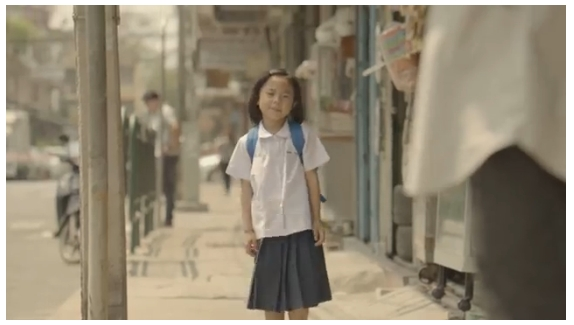
Video is a particularly strong medium for argument.
Every frame is a claim.
Elsewhere, we have discussed countless implications of the contents of individual frames, all of which are small claims in a larger argument. We can’t be sure how we’re being manipulated until we understand the entire argument, but watching pieces out of context gives us the best opportunity to see the mechanics of argument at work. When we watch in the “proper” sequence, with the “appropriate” soundtrack, we can be sure we’re being manipulated, and that we’re willing conspirators in our own persuasion.
We conspire to be persuaded.
We’re hoping for a rewarding experience. Do we get goosebumps, or choke up with emotion, after 2 minutes of wordless video about total strangers? That doesn’t happen by accident. That happens when we’ve been persuaded by an argument to believe that something has happened (or that it at least represents a human experience that could happen).
- As you prepare your Visual Argument, watch the videos as if you didn’t already know the argument.
- Consider what a single frame communicates without its full context (which has been supplied to you by the video’s creator, whose job is to persuade you).
- Create your own posts to include this degree of analysis and interpretation.
It’s selling life insurance.
The text at the conclusion says:
Thai Life Insurance. Believe in Good.
So, is it a public service announcement that urges us to make small differences in the world we pass through every day? No. It is not. It’s an ad for life insurance.
The target audience is a young man with a child.
Make no mistake, this message from an insurance company is designed to sell men a life insurance policy to protect their children.
I admit, that sounds like an outrageous claim. You watched the video. You most likely didn’t feel you were being encouraged to buy life insurance. I didn’t either. WHILE I WAS WATCHING IT. While I was watching it, I was compelled to follow the logic of the narrative; I was swept along by the soundtrack, instructed when and what to feel; I was manipulated into seeing the patterns in the repeated images: three times the bananas on the doorknob. And so on. I was being taught something unwittingly.
The argument type is Analogy
Given time to reflect, though, I have decided this:
Paying for a life insurance policy every month, which does me “no direct good,” but which benefits my dependents when I’m gone . . .
is VERY MUCH like:
performing small but significant acts of generosity—such as making regular cash contributions from a light wallet with no tangible benefit for myself—for a little girl whose mother sits alone on a piece of cardboard with no father in sight and a dependent daughter to put through school.
Periodic donations are like insurance premiums
That’s right. The young man is “paying premiums” that add up to a cash benefit for the girl whose father is gone. The young man is the stand-in for the father who dies but who has left behind a life policy with a death benefit that will put her through school.
That’s why the emotional payoff of the piece hits first when the man realizes he has helped “his little girl” get her education when there’s no one there to sit next to Mom.
OK? Get to work. Tell me a story like that one about the video you choose to analyze.


 The Gamer 2.0
 SleepyCat
 Coffee Lover 03
 doglover7025
 Snowman10
 excellentstudent27
 Gymrat
 hockeyfan
 holistic25
 ilovebeesss
 ilovemydog
 The Gamer
 Naturechild101
 BreakingBad45
 ravensfan8
 temporal111
 thatpersonoverthere
 toetio
 username1132005
 Calm&Patient
 webbwrestler135
 Counterintuitive Spring 2024